

Universitetsavisen
Nørregade 10
1165 København K
Tlf: 35 32 28 98 (mon-thurs)
E-mail: uni-avis@adm.ku.dk
Talk
Talk — What happens when art and science meet? Join us for the second Yonder Talks colloquium, featuring artist Ligia Bouton in a talk titled Time-slip Spectrum: Exploring the collision of art, science, and history. Drawing on the astronomical work of Tycho and Sophia Brahe and her own research trip to the Subaru Telescope in Hawai'i, Bouton explores how a single piece of data can weave together disparate moments in history and geography. Followed by a reception. All welcome!
Date & Time:
Place:
Margrethe Bohr Salen, located in the Niels Bohr Building at Jagtvej 132, 2200 København. You'll find it on the ground floor, next to the canteen.
Hosted by:
Yonder Art•Science at the Niels Bohr Institute (https://yonderartscience.com/)
Cost:
Free
We are excited to continue the Yonder Talks series, a colloquia series hosted by Yonder Art•Science at the Niels Bohr Institute, about synergies between art and science. The talks will share inspiring stories about the possibilities that appear when artistic and scientific methodologies intersect. Whatever your discipline, we hope these talks will inspire you and be the seed of something new. Each colloquium will be followed by a reception. Everyone is welcome!
Title: Time-slip Spectrum: Exploring the collision of art, science, and history
Abstract: This talk will explore the “new star” studied in 1572 by the Danish astronomer Tycho Brahe with the help of his sister, Sophia, who was an astronomer, chemist, and historian in her own right. We know now that this star was actually a Type 1A supernova which currently exists only as a remnant, a giant cloud of expanding debris made up of mostly iron particles. In 2008, a light echo of the original supernova was discovered, allowing scientists to experience an event that happened 400 years in the past for a 2nd time. This form of time travel has inspired my interest in how a piece of data, such as the light spectrum of SN1572 captured at the Subaru telescope during observations of the light echo, can be used to weave together disparate moments in history and geographical locations that are thousands of miles apart. Bringing together photographs and footage of the ruins of Herrevads Castle in Sweden where the Brahe’s first observed the supernova with imagery from my recent research trip to Maunakea in Hawai’i to visit with scientists at the Subaru Telescope, I will also address how my work combines digital mediums directly with materials produced in a Type 1A supernova explosion such as iron and common silicon compounds.
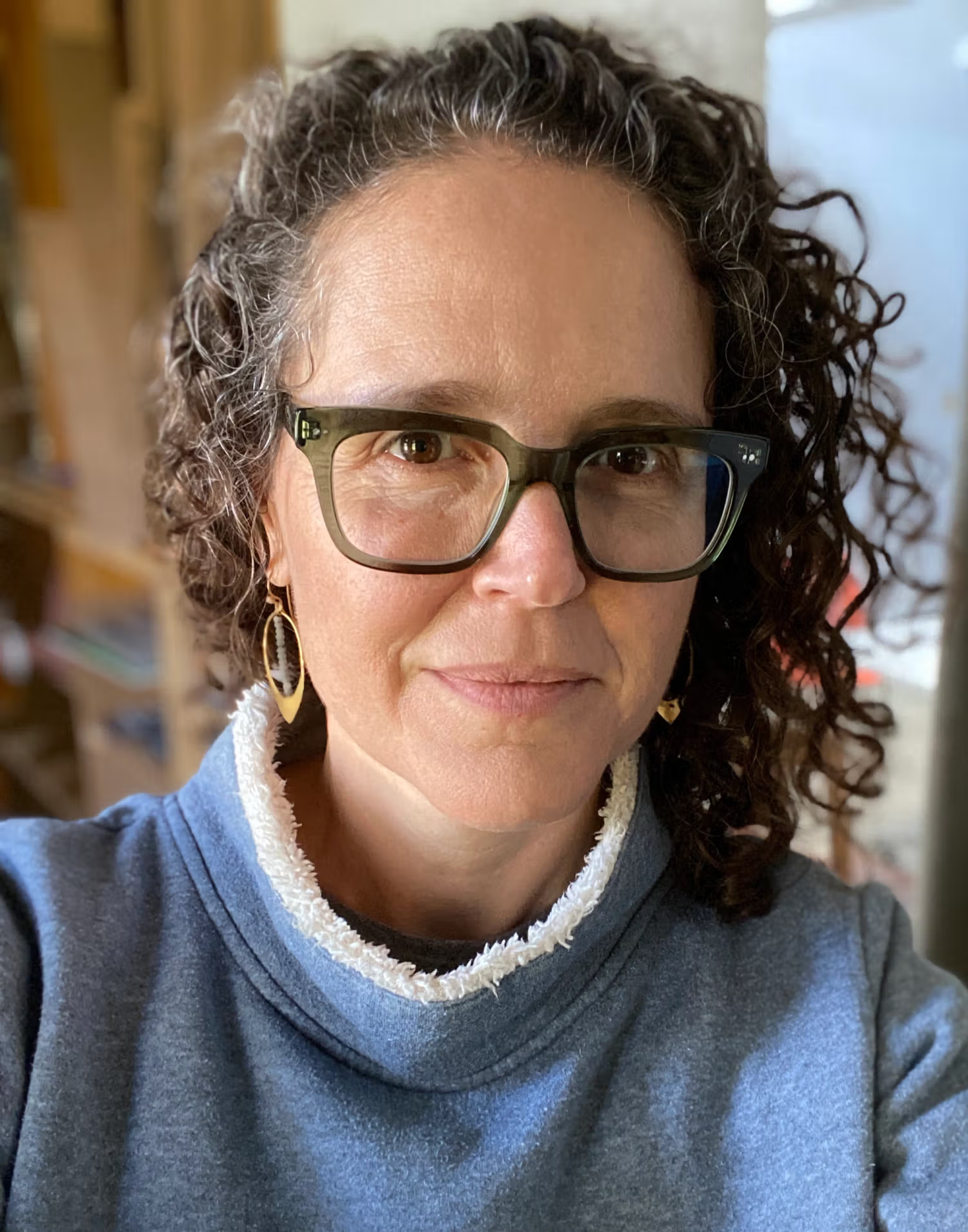
Speaker bio: Ligia Bouton is an artist in residence at Yonder Art•Science at the Niels Bohr Institute, where she will be hosted during the whole month of August 2026. She was born in Sao Paulo, Brazil, and spent her childhood in London, England. She received her education at Vassar College and at the Mason Gross School of the Arts at Rutgers University, New Jersey USA. Recent projects have been shown at the Copenhagen Contemporary as a part of “Yet, It Moves!”, the Crystal Bridges Museum of American Art, the National Museum of Women in the Arts in Washington D.C., Guildhall Art Gallery in London, Minneapolis Institute of Art, SITE Santa Fe, the New Mexico Museum of Art, the Philadelphia Art Alliance, Bellevue Arts Museum, the Independence Seaport Museum in Philadelphia, and the Boulder Museum of Contemporary Art.
Her work is based in sculpture and photography. She also uses video, drawing, and a wide range of installation techniques to examine narratives from science and history in order to explore the human experience of time itself. Her current work is dominated by questions such as: How can our immediate environments and daily experiences instruct us in how to understand events happening long ago or at immense distances out in the Universe? She seeks out research experiences that place her in a position of daily uncertainty, where she is struck by the modes of communication we use to disseminate information and how these modes are often coded so that only a small group of people can understand the layers of data. She incorporates this data into photographs, videos, and sculptures to use this disconnect in understanding, between those who understand the code and those who don’t, as a vehicle to explore broader narratives about our human experience.
A reception with light snacks and beverages will follow after the talk in the atrium just in front of Margrethe Bohr Salen.
See https://yonderartscience.com/ for more info about Yonder.