

Universitetsavisen
Nørregade 10
1165 København K
Tlf: 35 32 28 98 (mon-thurs)
E-mail: uni-avis@adm.ku.dk
Debate
Debate — En debat om videnskabernes, særligt humanioras, rolle og ansvar i en verden af kriser. Med udgangspunkt i en kritisk diskussion af de nye materialismer er debattens hovedspørgsmålet, hvordan videnskab, politik og etik bør forholde sig til fremtiden.
Date & Time:
Place:
Main hall at Studenterhuset, Købmagergade 52, 1150 Copenhagen
Hosted by:
Thinking the European Republic of Letters - CEMES, University of Copenhagen
Cost:
Free
The present is intolerable — and has been so for decades.
Democratic corrosion, global warming, extreme inequality, colonial violence and genocide are unfolding through processes of catastrophic mutual reinforcement. Our epoch is dreadful in the most literal sense and screams for both careful scrutiny and action.
From the humanities and social sciences, the most dominant and defining response of the past several decades has been the rise of the new materialisms.
So, where are we now?
Looking back, did the new materialisms succeed in enabling us to apprehend our time in thought? Did their critique of secularism, autonomy, finitude and universality — and their critique of critique itself — bring us any closer to coming face-to-face with the crises of the present and confronting what is to come? Perhaps they brought us too close to the point that we’ve become indifferent to the bigger picture, that is, to those warnings that were always there?
Was it true that the future lies behind us — before modernity? Or is it possible for the future to present itself as something other than an ominous threat, a fateful curse? A chance, even? Rather than making predictions, we should, perhaps, focus on reopening the horizon of the future, a more radical future, one that requires our involvement through interpretation and critique.
Instead of reclaiming the past, can we reclaim the future and make it inhabitable — a home for humans and the world?
These questions are the center of the debate that takes place after three short presentations:
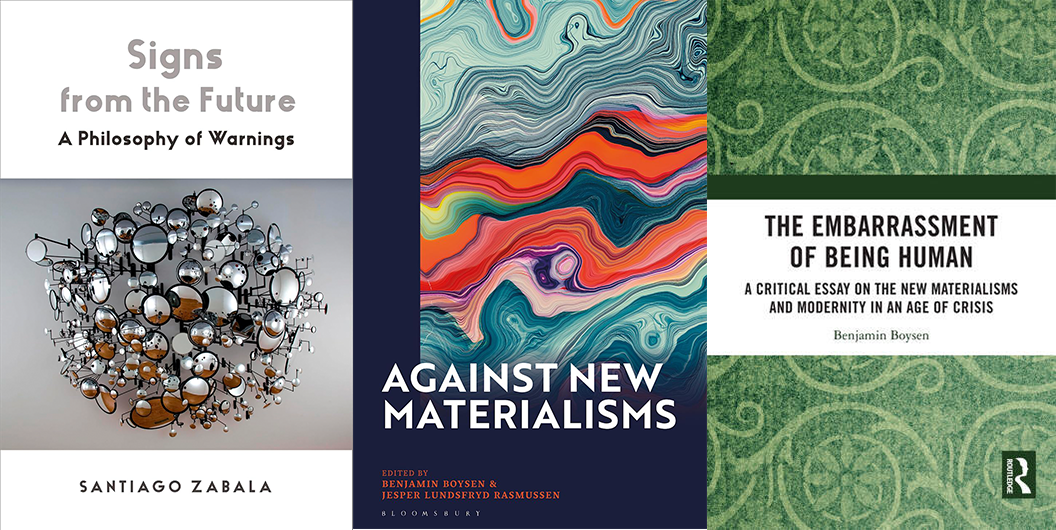
Santiago Zabala: The Future Rests on Warnings. Hermeneutics Against Realism’s Global Return to Order
Benjamin Boysen: Sharpening the Pencils with Which to Write ‘the Poetry of the Future’. Defending Human Universalism, Potentiality, and Democracy
Jesper Lundsfryd Rasmussen: Asymmetry in Ethics to Come. New Dimensions of Responsibility
Steen Nepper Larsen moderates the discussion.
No participation fee.