





Universitetsavisen
Nørregade 10
1165 København K
Tlf: 35 32 28 98 (mon-thurs)
E-mail: uni-avis@adm.ku.dk
—
Science
Banality of evil — People who are under pressure in their professional lives are willing to act brutally to climb the career ladder. And this can be exploited. In a new University of Copenhagen study, political science associate professor Adam Scharpf has examined data from from the Argentine armed forces.
It is a pattern repeated throughout history. A dictator comes to power. He quickly sets up a secret police force. It has no scruples. It murders, tortures, and makes people disappear.
Researchers have for many years tried to explain what kind of people would volunteer to do the dirty work in the service of a dictator. The assumption is often that it has to be a job for a particularly ruthless type of person with a dubious moral compass. But according to Adam Scharpf, an associate professor of political science at the University of Copenhagen (UCPH), this assumption is rarely true. More often, there is a completely different, and very banal, reason why people sign up to commit such atrocities. The reason is deeply human. In fact, it can all be boiled down to something as simple as career pressure.
Our democracies are eroding. We see this both in young and established democracies.
Adam Scharpf, associate professor of political science
»Even the most brutal, illegal, or immoral actions committed by organisations are carried out by individuals who go through career problems,« says Adam Scharpf.
Together with his colleague Christian Gläßel from Hertie School, Adam Scharpf has set out to investigate what it is that has ordinary people committing atrocities. On 13 February, they published the book Making a Career in a Dictatorship: The Secret Logic behind Repression and Coups, where they explain the phenomenon.
»Hannah Arendt described it in her famous work Eichmann in Jerusalem: A Report on the Banality of Evil. In our book, we show how this banality is generated.«
In their research, Adam Scharpf and his colleague Christian Gläßel focus on autocratic regimes.
»We found it hard to think of any organisations that are more evil than the security services in dictatorships. That is why they are the focus of the book.«
READ ALSO: As Trump tears up the rulebook, academics use a new concept
PROFILE

Adam Scharpf is an associate professor of comparative politics at the Department of Political Science at the University of Copenhagen (UCPH). His research focuses on autocracies, specifically, their security apparatuses.
He studied Politics and Public Administration at the University of Konstanz (2005–2012) and completed a PhD in political science at the University of Mannheim (2012–2018).
The book Making a Career in a Dictatorship: The Secret Logic Behind Repression and Coups is authored by Christian Gläßel (Hertie School) and Adam Scharpf and will be published on 13 February 2026 by Oxford University Press.
It is of particular importance to do research on autocracies now, according to Adam Scharpf. 70 per cent of the world’s population live under autocratic regimes, and autocracies are on the rise globally.
»Dictatorships are making a global comeback. Our democracies are eroding. We see this both in young democracies and in more established democracies. Some of them are even shifting directly from being democracies to becoming autocracies.«
With dictatorships comes violence directed against the population. And that violence is carried out by specific people.
»So the question practically asked itself. Who is willing to do these things, and why do they do them?«
Autocratic regimes are rarely interested in being investigated by a couple of researchers. So they had to dig into historical data to uncover what the incentives are for volunteering for a security service. They looked closely at historical cases and found data from the Argentine military stretching back to the 1800s and all the way up until the 1970s, when the country was under a military dictatorship.
»By examining historical dictatorships, we were able to uncover the entire logic behind career pressure. We could then apply this logic to the current trends we see in several countries today.«
The material from Argentina contained information on every officer who had ever served in the country’s army. Data on the officers’ lives and careers had been recorded in a highly systematic way. This allowed researchers to build up an extensive dataset with enough information on individuals to be able to examine who did what, and why they did it.
Career pressure exists in virtually all organisations, according to Adam Scharpf. It exists in the military, gangs, banks, and in universities. For career pressure to arise in an organisation, three elements need to be present: A hierarchy, a system of promotion, and a pyramid structure. Any normal workplace, in other words, where you can work your way up. And where people gradually drop out the higher up the system you go.
»It’s almost impossible to imagine an organisation that does not have these three components,« says Adam Scharpf.
The problem occurs when employees reach a level where they can no longer climb higher up the career ladder. They get stuck. One shady character at the top of the system can then decide to exploit the employees’ desperation. There will always be employees willing to carry out the boss’s dirty work if a promotion is offered in return.
Leaders who choose to recruit career-pressured individuals can secure a loyal, personal, unit whose professional progress and career prospects are tied to the leader. This is the reason the employees never say no to tasks, no matter how illegal they may be.
The mechanism is so powerful because, deep down, we are driven by the pursuit of status
Adam Scharpf, associate professor of political science
»Instead of focusing only on leaders, which is what we most often do, it may be at least as important to look at the employees in the middle or at the bottom who sustain the leader’s power.«
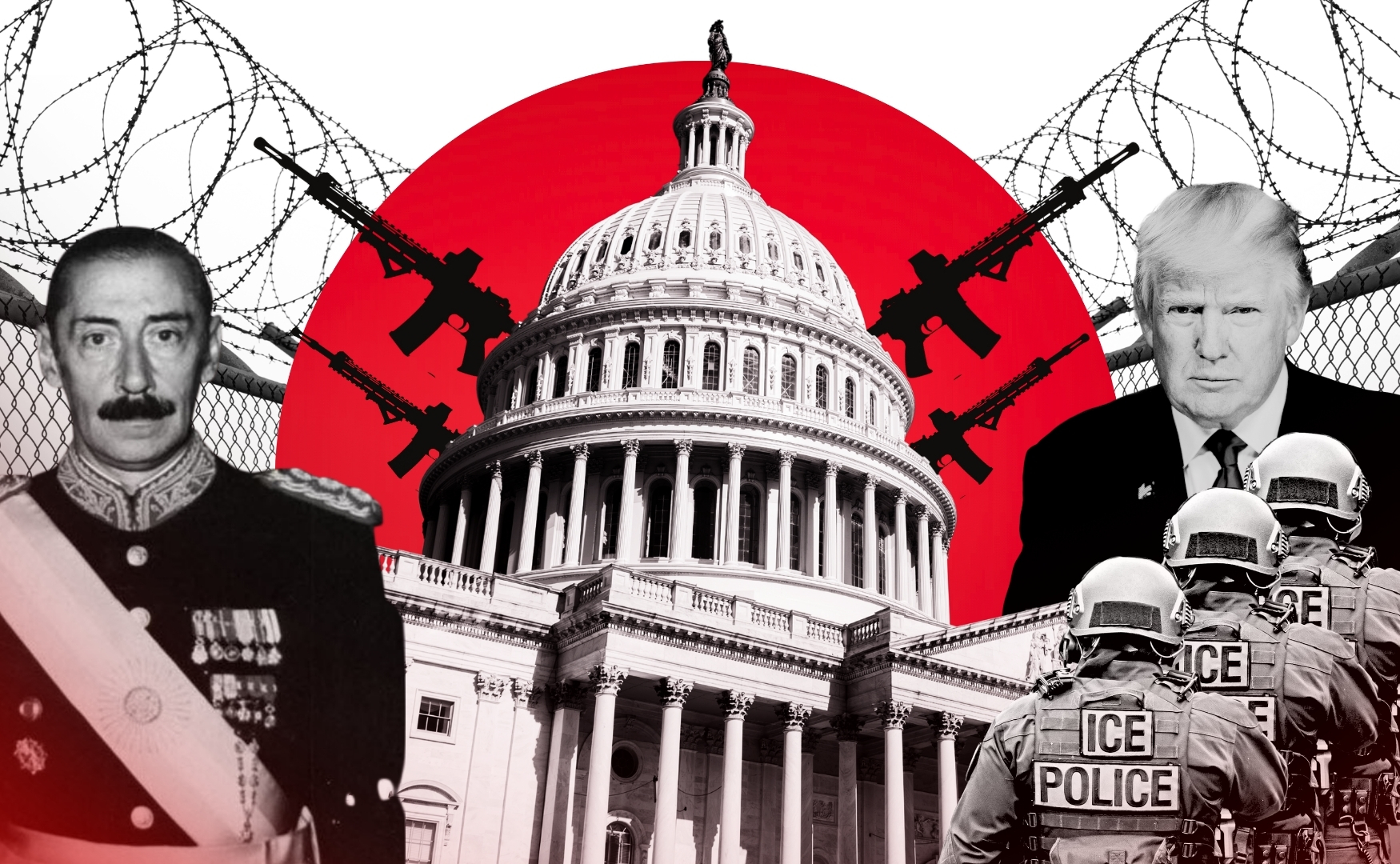
Adam Scharpf points to ICE agents in the United States as a contemporary example. Many of the agents have a criminal background — they may, for example, have tested positive in a drug test. According to the official recruitment website for ICE agents, they do not need a university degree to be hired.
»This fits perfectly with the logic that we uncover in the book. These people are willing to carry out any illegal and violent order. They do everything their political leader asks of them, because the state essentially provides them with a professional lifeline.«
Career pressure explains both why some individuals are extremely loyal to autocratic leaders, and why others choose the most disloyal act that you could imagine — to take part in a coup.
»Ultimately, individuals who experience career pressure have two choices. If no leader offers them a promotion, the other option is to carry out a coup and hope for career advancement in the new regime.«
According to Adam Scharpf, anyone can end up in a situation where, under career pressure, they can be persuaded to do things they otherwise would not have done.
»The mechanism is so powerful because, deep down, we humans are driven by the pursuit of status. We need something that makes us stand out. It doesn’t matter whether you seek power, authority or recognition,« he says.
»The higher the position, the more status you gain. That’s why most people want to climb the organisational hierarchy.«
Most people will go a long way to achieve their professional goals, according to the researcher. Adam Scharpf uses the university as an example of an organisation where the number of positions quickly decreases higher up. This leaves a large group of people competing for very small number of professorships:
»If you ask any PhD student, many would probably say that they are willing to do anything, and that they are happy to work both day and night to reach the next step.«
We know that career pressure oils the machinery of autocratic political machines
Economic downturns increase the career pressure. When the job market has dried up and there are few vacancies, it becomes difficult for individuals under career pressure to switch jobs or sectors.
Adam Scharpf offers an example from the book. During the Weimar Republic, there were many public-sector employees with university degrees. Despite their high education level, they were still willing to serve under Hitler’s regime. This was because the labour market in the Weimar Republic was saturated with university graduates. As a result, many well-educated, ambitious, young people went along with upending the system.
»Career pressure can in this way lead to public servants being willing to take part in anti-democratic work, or even to completely undermine the system.«
READ ALSO: Rector: Academic recruitment is now more fragile
According to Adam Scharpf, there is no simple solution to the problem of employees being persuaded to carry out actions that may ultimately undermine democracy. It is difficult to build an organisation without generating career pressure. And when a system is built like a pyramid, it will always produce winners and losers. This is unavoidable.
»No organisation is uncrackable — there is no state or security apparatus that cannot be taken over and used in a harmful way to do terrible things.«
But something can be done, the researcher says. And it is necessary to intervene before things go wrong. You have to first find out what level of an organisation it is where the career pressure is particularly intense.
»You have to detect them before the act, because once you realise that there are enough people for, or against, a system, it is already too late.«
Once the career-pressured individuals have been identified, they can then be offered a favourable exit. This will allow them to switch career paths without excessive hardship.
»We know that career pressure oils the machinery of autocratic political machines. We have to deprive autocratic leaders of the opportunity to have people that they can single out to carry out their dirty work.«
This article was first written in Danish and published on 5 February 2026. It has been translated into English and post-edited by Mike Young.