



Universitetsavisen
Nørregade 10
1165 København K
Tlf: 35 32 28 98 (mon-thurs)
E-mail: uni-avis@adm.ku.dk
—
Academic life
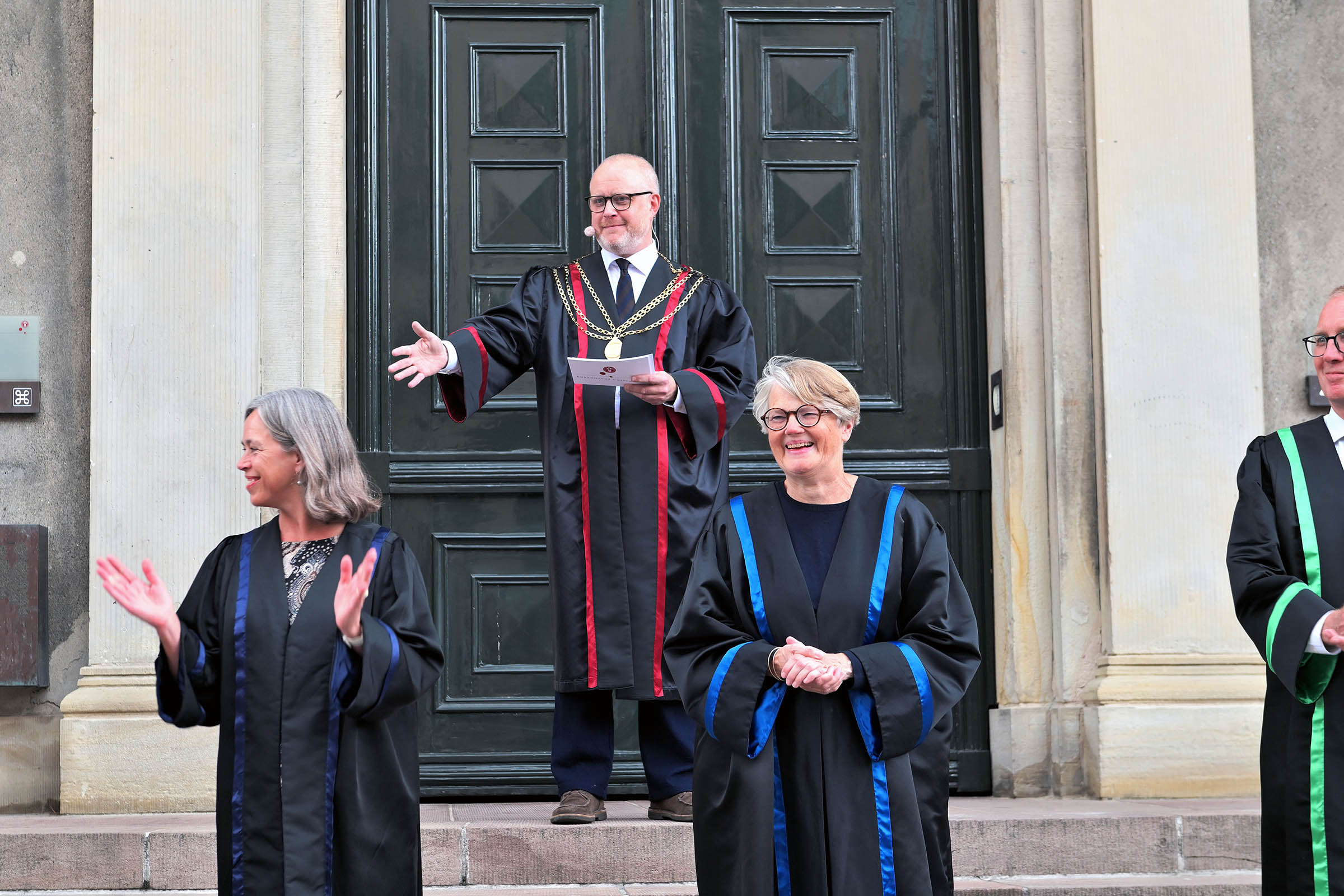
Matriculation 2026 — With the symbolic handshake new students are welcomed to UCPH by The Rector as citizens of the academic republic.
Check against delivery
Dear students!
Welcome to the best day of the year at the University of Copenhagen.
The day where the air around the University is vibrating with faith, hope and science.
The day where the University’s old eagle up there drinks its annual energy drink of freshly squeezed study dreams and is just about to take off in sheer excitement.
The day where the deans, prorectors and the University Director are smiling such big smiles they could supply five hungry data centres with electricity of joy.
[The Rector introduce University Management]
You may have noticed the gowns.
We don’t follow fashion trends. We seek the truth
And no, we don’t follow fashion trends. We seek the truth.
But I can tell you that we do have relaxed our dress code since the Middle Ages.
According to the University’s old rules from 1479, the rector had to wear »a fur collar in the winter« and »a silk gown in the summer …«
And a janitor always had to go in front of the rector … carrying a stick.
I’m pleased that I no longer have to wear a silk gown, or bring a janitor, to the gym.
Nonetheless, I was hit by a crisis at my local gym last autumn.
It happened at the incline bench press. The exercise where you from an inclined position press up weights by extending your arms.
I was a beginner and had been too ambitious.
I couldn’t lift it.
But then, something beautiful happened.
Help each other take some weight off the expectations and the burdensome doubts
Out of nowhere, two guys came rushing and lifted the weights away while they laughed and said: »We can’t have that the Rector is squashed.«
It’s such small acts of kindness that show you are attentive and understanding of other people.
To see those who feel under pressure.
To help those who feel under pressure.
This very much applies to you.
Especially during study start when you are carrying the weight of the world on your shoulders.
The pressure of big expectations.
And the heavy doubts that may feel like a barbell pressuring against your chest:
Help each other take some weight off the expectations and the burdensome doubts.
Turn off your Snap Map. It only shows where you are not.
Turn on your physical presence.
An attentive look means more than you know.
A helping hand can save a rector.
Do something. Do something together.
Do something that gives you a sense of belonging.
It doesn’t have to be related to your studies.
Go to the gym together.
Do brain exercises like playing board games.
Relax with morning yoga or a movie night.
The aim doesn’t matter.
But being together does.
To those of you who grew up in the »right« zip codes.
Communities should not be exclusive clubs – but an open door
To those of you who can go home to mom and dad for a real meal.
To those of you who don’t think you need new friends in addition to the ones you already have from efterskole, high school and højskole:
Communities should not be exclusive clubs – but an open door.
Open-mindedness yields more profit in life than real estate.
»Sure, Rector. That’s all good advice. But what about the serious, and almost unbearable, problems in the world?«
War in Europe and the Middle East.
Democracy and NATO on their way to retirement.
Our little sisters on their way to military service.
Europe transformed into a museum of a world from yesterday.
Southern Europe transformed from summer holiday paradise to a fire zone.
Climate curves on track for catastrophe.
Animal and plant species becoming extinct.
And what about AI? Are academics also an endangered species?
No, we NEED you to solve the planet’s problems.
And no, AI will not take your jobs.
I know you may be tired of hearing the same old tune about artificial intelligence at the traditional rites of passage where you go from one life stage to the next. Confirmation, 18th birthday, high school graduation – and now today.
AI can give you the answers, but not ask the questions
Often with your parents or principal as the techno-phobic prophets of doom who long for times when telephones had a rotary dial
and you spent an entire week waiting in suspense for the next Donald Duck issue.
I’m neither a doomsday prophet – nor do I worship the tech God.
But I do not believe in the ostrich effect – strudsepolitik – in burying your head in the sand and waiting for AI to go away.
You must be able to master a world where AI is everywhere. But that doesn’t mean you should use AI for everything.
AI can do many things.
It can read an entire library in seconds.
It can write a summary of world history in twenty lines.
Or even crack the code of an impossible mathematical formula.
But there are also things AI cannot do.
AI can solve a specific task, but not the overall problem.
It can fix bugs in coding, but not secure the system.
It can give you the answers, but not ask the questions.
Let me tell you a story.
A few years ago, one of our physics students, Albert Sneppen, was in corona isolation in his dorm with a good friend and a bottle of wine.
They were looking at the stars, while Albert tried to explain black holes in the universe. He didn’t quite succeed.
But then, Albert gazed at a rice-paper lamp from IKEA and imagined a black hole – and an idea formed in his head, as simple and beautiful as the truth often is.
Right then and there, he came up with a theory about how black holes work just like mirrors.
This story tells us what humans – and science – can do, and what machines cannot.
The ability to pursue random impulses or odd experiments.
The ability to think wild thoughts across disciplines.
The ability to imagine a completely new understanding of the world.
The ability to wonder.
And, not least, the story tells us something about how a conversation between two friends under the stars can be quite unique.
Taking a degree, learning and being able to use it is not a solo performance, it’s a team sport.
You need to exercise alone, yes, but the pieces will often fall into place in the company of others:
During conversations in the dorm kitchen, where you are trying to explain what you are studying.
In study groups, where you crack the code to a shared problem and benefit from different approaches and angles.
In teaching, where you students will not just be learning from us researchers. We will all learn – together.
As a teacher, I often experienced students who asked good questions in class.
Sometimes, my best answer was »I don’t know. I need to think about that for next time.«
As with all teaching, that conversation requires trust between the teacher and the student.
AI challenges that trust, especially if we believe in overly confident answers to complex questions.
Now let’s proceed with another thing that AI cannot do, a classic ritual here at the University of Copenhagen:
The symbolic handshake
With the handshake, you will become citizens of the academic republic.
That means: your names will be registered at this address.
Luckily, for this exercise – with thousands of repetitions – I will get a helping hand from the Prorector for Education,
Kristian Cedervall Lauta.
With the handshake, you promise that you will follow the University’s rules from the Middle Ages, written in Latin.
It basically just says: Behave yourselves and take care of each other.
But I think we should shake hands on something more:
See those under pressure.
Help those under pressure.
Drop the easy solutions of AI and practice formulating the difficult questions instead.
And the most important thing: Remember to sit under the starry sky with your fellow students – and wonder.
New students of 2026, welcome to the University of Copenhagen.