



Universitetsavisen
Nørregade 10
1165 København K
Tlf: 35 32 28 98 (mon-thurs)
E-mail: uni-avis@adm.ku.dk
—
People
AI — Over the next three years, artificial intelligence is to be integrated into everything from research and teaching to administration at the University of Copenhagen. The new deputy prorector, Morten Axel Pedersen, will spearhead this transformation. And his message is clear: We can wait no longer.
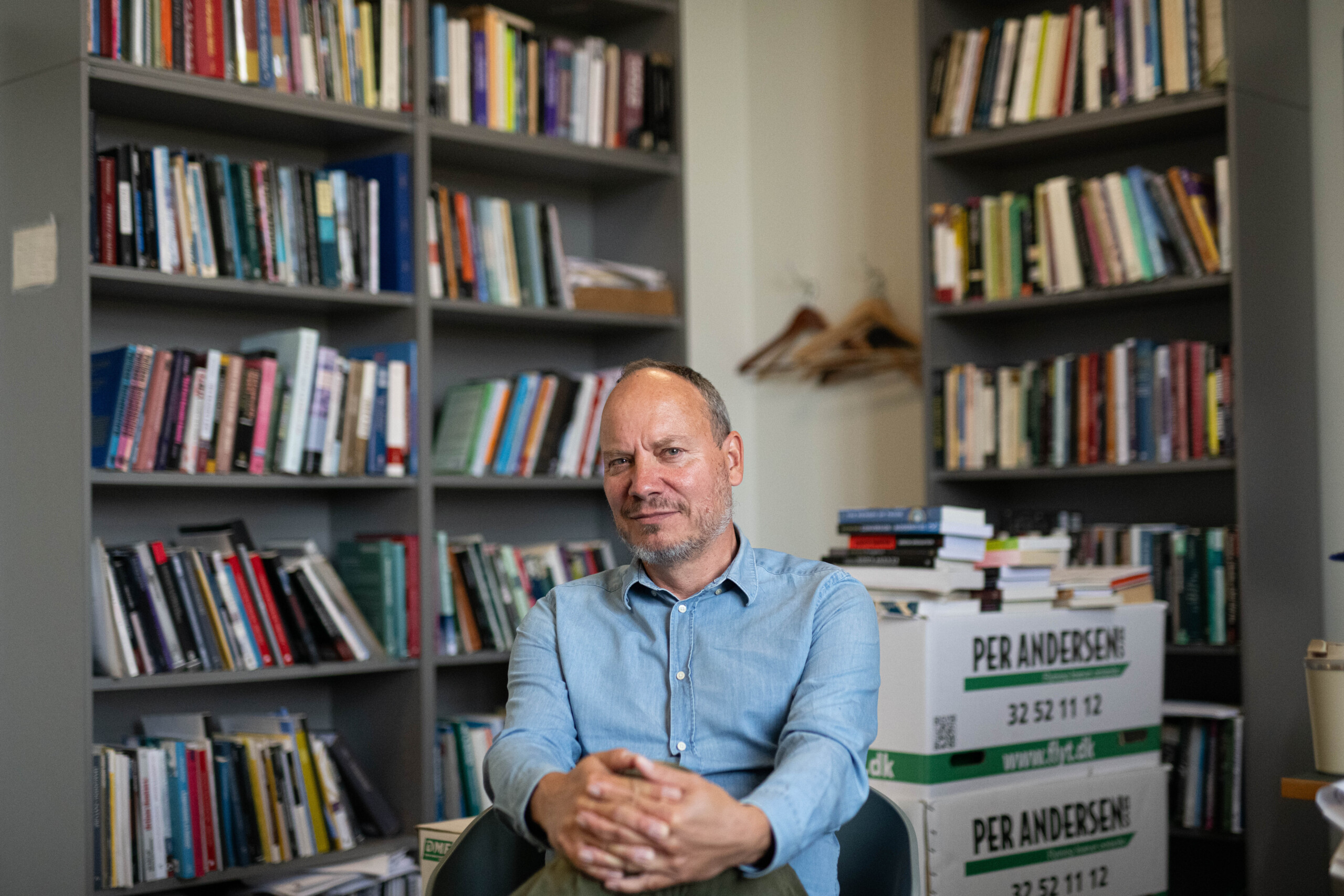
The walls of Morten Axel Pedersen’s office at CSS are lined with tall bookcases filled with large, weighty textbooks on anthropology, data science and artificial intelligence.
And at a time where AI seems to be permeating ever more aspects of our lives, it makes for an almost oddly analogue setting for our interview, which is about Morten Axel Pedersen’s new role as deputy prorector for AI at the University of Copenhagen.
A new AI initiative
UCPH is investing DKK 110 million in a three-year AI initiative with two overarching objectives:
AI at UCPH: The university will determine when and how AI should – and should not – be used in research, education and administration.
UCPH with AI: The university will explore AI’s implications for society, the labour market and education, and address issues including ethics, regulation, digital sovereignty and climate impact.
Source: UCPH
From 1 September 2026 and for the following three years, he will lead a far-reaching new AI initiative intended to equip both the centuries-old university and contemporary Danish society to seize the technology’s opportunities and navigate the changes it brings.
»The time has come for us to grasp the nettle. We can’t wait any longer. The media have run many stories about what artificial intelligence means, particularly for exams, and about whether students use the technology to ‘cheat’ …« he says, quickly adding that I should put ‘cheat’ in quotation marks.
»Because the discussion is much bigger than that,« he explains.
110 million danish kroner has been allocated to the initiative. The funding will, among other things, support a new AI office, a cross-university task force, a number of AI labs, and a substantial strengthening of UCPH’s IT department and digital infrastructure.
When the three years are up, Morten Axel Pedersen hopes there will be clear guidelines for when students, researchers and administrative staff use AI – and when they do not use AI.
»Every discipline here must work out what AI means for it. My role is to get the work under way and keep the momentum up where necessary, but I should not be the one drawing the line. That needs to be determined by colleagues within each individual discipline,« he says.
If you were to rewind the clock just five years, few would have guessed that
Even Morten Axel Pedersen, who, as a chief researcher at the National Centre for Artificial Intelligence in Society (CAISA) and former director of the Copenhagen Center for Social Data Science (SODAS), has worked on everything from big data and artificial intelligence to the ways digital technologies shape our behaviour and society, is surprised by where we stand today.
»Artificial intelligence has existed for many years. What happened four or five years ago was that we entered a new era of generative AI, in which you could suddenly talk to a chatbot that has suddenly become really good,« he says, before continuing:
»And nobody saw that development coming. Even the most hardcore machine learning or programming types have been surprised by how well the stuff actually works. In many ways, it is still a bit of a mystery that it works.«
The pace of development has been rapid, prompting concern in some quarters that it is moving too fast. Are we taking the time to consider the consequences – and will we, as humans, lose the ability to think for ourselves?
I don’t think it will turn out that we lose brain cells from using AI. And I doubt that it will make us fundamentally less intelligent. But there is clearly a risk that we will become lazy
However, the new deputy prorector for AI is not overly concerned about that.
»I regard that part of the conversation as unnecessary panic. I don’t think it will turn out that we lose brain cells from using AI. And I doubt that it will make us fundamentally less intelligent. But there is clearly a risk that we will become lazy,« he says, stressing how important it is to discuss the technology’s downsides.
»Whenever there is an opportunity to make things easier, that is what we do. And particularly in our degree programmes, we need to introduce some friction and say: One day, you will be allowed to take the easy route, but first there are many things you need to learn from the ground up, so that you have a basis for making the right decisions when you use AI.«
Morten Axel Pedersen also believes it is important to focus on the many opportunities AI creates at a university – an institution that exists to generate new knowledge.
»I find it fundamentally exciting that there is this new thing in the world which we are only just beginning to understand. The university should – and must – be curious about it,« he says, continuing:
»Researchers across the faculties talk with great enthusiasm about all the new possibilities. I hear from several sides that they feel they can do so much more, that it is as if their team has grown tenfold. Personally, I believe that this new capacity will lead to major scientific discoveries.«
Most students use AI to some extent in their studies, and this should not automatically be prohibited or regarded as cheating, says Morten Axel.
»But university students must still learn how to think. And in the future, we may need to be more explicit about what it means to think, just as we need to consider how to foster the motivation and curiosity to learn how to think.«
The new deputy prorector acknowledges that it will not necessarily be easy to convince young students that it is interesting and important to sit down and read a long, dense theoretical text instead of simply asking AI for a few bullet points.
»That will be a very important task. We need to educate people both with and without AI. In the coming years, we need to focus on what the purpose of going to university really is. It is about education – about acquiring the knowledge, skills and competencies that enable people to function and work professionally within a given field,« he says, adding:
»But it is also about bildung and judgement: being able to distinguish between right and wrong, as only a human can,« says Morten Axel Pedersen.
Many degree programmes will probably need to revisit their learning objectives and consider how they each relate to AI, he says.
»I do not want to dictate how individual programmes should approach this, but I can imagine that, for many of them, it would make sense to identify entire courses – or parts of courses – where AI use is permitted, and then actually examine students on precisely that: how they used AI to solve the task,« he says.
Profile
Professor of anthropology and social data science.
Former leader and co-founder of the Copenhagen Center for Social Data Science (SODAS) at the University of Copenhagen.
Chief researcher at the National Centre for Artificial Intelligence in Society (CAISA).
Has served as project manager for the DISTRACT research project on digitalisation and human attention.
Takes up the role of UCPH’s first deputy prorector for AI on 1 September 2026. The position is a three-year appointment and reports directly to the rector.
But there must also be exams that students have to complete by hand, with pen and paper, says Morten Axel Pedersen.
»There are appropriate and less appropriate ways of using AI. And it is important that we insist that university graduates still have the ability to express themselves concisely, set up experiments or carry out mathematical calculations on their own. But if we can also create degree programmes where we professionalise, systematise and critically reflect on the use of AI, then that becomes a competency in itself.«
The ability to use and manage AI effectively is already a skill that is flourishing in several areas of research, the deputy prorector says.
»Within empirical social science, the use of AI has already brought about major and significant changes. Previously, for example, you had to clean a dataset manually before it was ready for analysis – now you can get AI agents to do it. That does not mean we no longer need research assistants or similar roles, because a human being must still be there before, during and ultimately to check the work,« he says, continuing:
»But I believe that all degree programmes will include an element of management in the future. Most people who graduate with a master’s degree will, to some extent, become a kind of manager of AI agents. Judgement will be absolutely crucial in the labour market of the future.«
In addition to the philosophical, ethical and practical dimensions that Morten Axel Pedersen will help shape in the years ahead, he is also coordinating a long list of new, concrete AI initiatives at the university.
For example, UCPH IT is currently building an internal infrastructure based on local AI models, where sensitive personal data can be processed without the risk of ending up where it should not. Morten Axel Pedersen is aware that many people at UCPH are probably already using ChatGPT or Claude for a range of purposes.
»But you must not enter data that can be traced back to specific individuals into those models. I hope and believe that most people are already aware of that. We have a great deal of GDPR legislation, which we have learned to handle over the past ten years. And we need to continue doing so,« he says, continuing:
»It may seem cumbersome, but it is absolutely essential. In fact, I believe that data management and information security should be regarded as crucial skills – and therefore also as a competitive advantage in the job market,« he says.
It will affect our productivity, our political conversations and democracy, and the whole way we see ourselves and relate to one another
The new internal infrastructure will consist of a range of AI tools that students and staff can use for different purposes. The ambition is to create an AI platform where everyone can log in with their UCPH username and choose between different models depending on the task at hand, Morten Axel Pedersen explains.
There will be a transition period during which people may still be unsure about which AI models they are allowed to use and when. A number of so-called AI labs are therefore also on the way, where researchers can receive practical support in integrating artificial intelligence into their work.
»The AI labs will not be a place where all questions about AI from every academic environment can be answered. But they will be a place researchers can turn to if they have a specific project they need help with – for example, if they need help setting up a framework in an AI model for a research task,« he says.
The initiatives will be coordinated by a new AI office and a task force with representatives from all the faculties.
The major AI transition also comes at a cost. It is no secret that artificial intelligence relies on huge data centres, which require vast amounts of energy and generate substantial CO2 emissions.
And while the incoming deputy prorector does not yet have an answer to how UCPH will address that problem, it is important to him to stress that he is aware of it.
»It is incredibly important that both researchers and students have access to the best and latest technology in the field. But in the longer term, I would like to explore whether we can assess how it contributes to our overall climate footprint,« he says.
The forthcoming AI Platform is also intended to help users assess how resource-intensive an AI model it makes sense to use for a given purpose.
»There is no point taking the Ferrari to pick up breakfast rolls if a bike will do just as well,« he says.
Alongside his work as director of SODAS – and soon deputy prorector for AI – Morten Axel Pedersen is working on a book entitled Humanity after AI. It may be written in collaboration with AI, in which case the author credit ironically will read: Morten Axel Pedersen “with Claude”.
In the process, he has set out to examine a major philosophical question: What – or who – is AI?
»The most exciting thing about generative AI is that it does not actually behave like a machine – at least not in the traditional sense. During the Industrial Revolution, a machine was a mechanism that could repeat the same process and produce the same result over and over again,« he says.
Generative AI, by contrast, operates on probabilities, which makes it almost impossible to get it to produce the exact same answer twice.
The machines of the Industrial Revolution helped reshape virtually every political, economic and cultural relationship in society. Morten Axel Pedersen therefore imagines that generative AI could set a similarly far-reaching transformation in motion.
»It will affect our productivity, our political conversations and democracy, and the whole way we see ourselves and relate to one another.«
The position of deputy prorector has been created for three years, and the goal is that, by then, AI will be so integrated into the university’s academic disciplines and organisation that there will no longer be a need for a dedicated deputy prorector, AI office or task force. Morten Axel Pedersen is expected to spend three days a week at the new AI office.
»But it is a big task ahead of us. So let’s see whether it does not end up becoming more,« he says.