




Universitetsavisen
Nørregade 10
1165 København K
Tlf: 35 32 28 98 (mon-thurs)
E-mail: uni-avis@adm.ku.dk
—
International
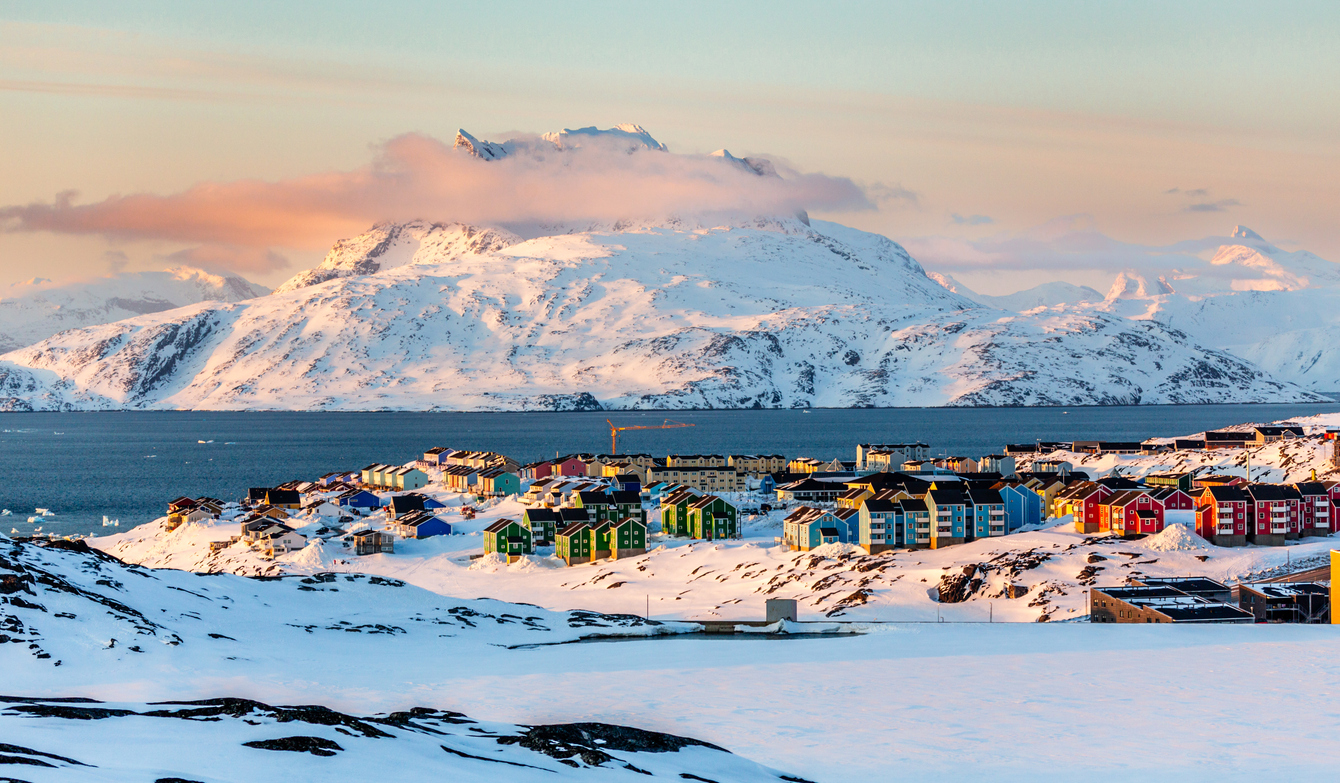
Future of Greenland — Two University of Copenhagen researchers adopt the concept of the »diplomatic extreme« to make sense of the US president’s statements on Greenland.
When foreign policy goes off-script, things get complicated. This goes for politicians and diplomats. But it also goes for researchers, who find it harder to analyse what is actually going on.
This is the situation in the Kingdom of Denmark after Donald Trump’s repeated statements about the United States taking control of one of its constituent parts, Greenland. The rigsfællesskabet or Kingdom of Denmark/Danish Realm consists of Denmark, Greenland and the Faroes.
At the University of Copenhagen (UCPH), two researchers have therefore adopted an analytical concept to help explain the actions of the American president, which they describe as the »diplomatic extreme«.
According to the UN Charter, the sovereignty of other countries must be respected, and that principle is being challenged here
Helle Krunke, professor at the Faculty of Law
Law professor Helle Krunke and assistant professor in political science Mette Marie Stæhr Harder use the term in a new study to analyse the current situation. Constitutional law, international law, and political power are typically understood within relatively stable frameworks — but now, according to the researchers, they are being disrupted.
»As legal scholars and political scientists, it is important to be able to ask: When are we operating outside the frameworks from which we usually analyse?« says Mette Marie Stæhr Harder about the aim of their study.
The project has just been published in the international journal Constitutional Studies and is based on the idea that the US president not only challenges specific agreements, but also the analytical models that researchers usually apply to international politics.
And Donald Trump’s insistence that Greenland should be handed over is, according to the researchers, not just provocative, but a breach of core principles. Especially since the US president has, on multiple occasions, stated he won’t rule out the use of force.
»A diplomatic extreme is when someone does something diplomatically that contravenes constitutions and international law. And at the same time, it is played out on social media in a way that feels extreme and intensely real,« says Mette Marie Stæhr Harder, who emphasises that Trump’s threats to the Kingdom of Denmark took a more tangible form after the US on 3 January attacked Venezuela and captured President Maduro and his wife.
The legal part of the study analyses the US president’s statements through a judicial framework. The researchers examine whether these statements challenge the constitutional framework of the Kingdom of Denmark — including the Danish Constitution and the Act on Greenland Self-Government— as well as international defence agreements regulating relations between the US, Denmark, and Greenland.
READ ALSO: Greenlandic Studies caught up in geopolitical tensions: »It makes me anxious«
And the conclusion is that Trump’s statements clearly violate core principles.
»According to the UN Charter, the sovereignty of other countries must be respected, and that principle is being challenged here — even though the US has, in multiple agreements with Denmark, recognised Denmark’s sovereignty over Greenland. This sovereignty is widely recognised internationally, including an International Court of Justice ruling from 1933,« says Helle Krunke.
The researchers reject Trump’s claim that the US needs control over Greenland for national security reasons. Existing agreements already grant the US far-reaching access.
»The 1951 agreement and the 2004 supplementary agreement were specifically created to allow the US pursue its security interests — including military interests — in Greenland,« says Helle Krunke.
Denmark talks about the Danish Realm being under threat, but the Greenlandic government does not speak of the Danish Realm in those terms
Mette Marie Stæhr Harder, assistant professor at the Faculty of Law
She stresses that the agreements allow the US to both expand and adjust its military presence without challenging sovereignty.
»The US can already safeguard both its own and international security. The Americans can set up more bases, deploy more troops, and install more security equipment under these agreements,« she says.
This, according to the researchers, makes it misleading to portray the situation as though the US needs manoeuvring space.
»It is, in fact, the US that itself has scaled down its presence in Greenland,« says Helle Krunke. There were thousands of US soldiers in Greenland during the Cold War. That number is now around 150.
The researchers analysed social media posts by Danish and Greenlandic government leaders during the crisis, which began one year ago.
The analysis shows that Denmark has primarily spoken of the threats as if they were directed at the Danish Realm and international norms, whereas Greenlandic leaders have framed the situation as a threat solely directed at Greenland.
»Denmark talks about the Danish Realm being under threat, but the Greenlandic government does not speak of the Danish Realm in those terms. From their perspective, it is Greenland that is under threat,« says Mette Marie Stæhr Harder.
READ ALSO: University of Copenhagen to boost Arctic Station co-operation with Greenland
In the analysis, the researchers point to how Greenland’s crisis communication has in several cases subtly distanced itself from Denmark.
»In some of the posts, Denmark is actually positioned somewhat on the same side as the US,« says Mette Marie Stæhr Harder.
He doesn’t play by the rules
Mette Marie Stæhr Harder, assistant professor at the Faculty of Law
At the same time, the researchers see no sign that Greenland — despite the nature of the situation — has used the crisis to try to expand its foreign policy autonomy.
»There is nothing in the posts to suggest that Greenland has attempted to widen its foreign policy role during the crisis,« says Mette Marie Stæhr Harder.
According to the researchers, one explanation may be that the Danish Prime Minister publicly emphasised that Greenland’s future will be decided in Nuuk.
»When the Prime Minister says that it’s up to Greenland itself, that sends a strong political signal of respect,« says Helle Krunke.
At the same time, she points out that under the 2009 Self-Government Act, there is still a legal approval step in Denmark.
»Even if Greenland votes for independence, it must still be approved by the Danish parliament,« she says.
The two researchers expect that Denmark will in the future try to pull the conflict back into a legal and institutional framework.
»The easiest way forward for Denmark is to make use of the existing defence agreements and try to convince Trump that he can protect US interests within these agreements,« says Helle Krunke.
But because the Trump statements do not follow the classic rules of diplomacy, they complicate the situation — also for researchers trying to analyse them.
»He is, after all, not playing by the rules,« says Mette Marie Stæhr Harder.
This article was first written in Danish and published on 9 January 2026. It has been translated into English and post-edited by Mike Young.