


Universitetsavisen
Nørregade 10
1165 København K
Tlf: 35 32 28 98 (mon-thurs)
E-mail: uni-avis@adm.ku.dk
—
Culture
Recreated — Artificial intelligence makes it possible to keep talking to someone long after their death. The technology is already widespread in some parts of the world, and University of Copenhagen professor Anders Søgaard believes it could become common practice in Denmark too. But what does it mean for grief when we breathe digital life into the dead?
When someone dies, they leave traces in the lives of those who live on.
There are photographs showing what they looked like. Perhaps even videos capturing their distinctive voice, intonation and facial expressions.
UCPH writes books
Books are being written all across the University of Copenhagen — as part of research projects, during lunch breaks and late into the night. Staff and students publish academic books, books of commentary and debate, and fiction.
In this series, the University Post asks not only what is being written, but why.
What gets the writing process started, and what do the authors hope to achieve with their books?
But photographs cannot answer back, and videos only repeat what has already been said.
And as the years pass, the memory of the person they once were begins to fade.
But what if it did not have to be that way? What if you could keep talking to someone you loved long after their death?
That is the question explored in Genskabt (Recreated, ed.), a book published earlier this autumn by technology journalist Marie Høst and Anders Søgaard, an author and professor of computer science at the University of Copenhagen.
Through conversations with each other, interviews and philosophical perspectives, they explore how artificial intelligence is affecting our relationship with death.
Søgaard has spent more than 15 years developing language models. His route into artificial intelligence began with philosophy, and his research today includes the philosophical and ethical questions the technology raises.
The work on Genskabt began with a phone call.
On the line was Katrine Martinussen, who had recently lost her husband, Stephan. During Stephan’s illness, the couple had decided to recreate him as a chatbot with an accompanying avatar, so she could keep talking to him after his death.
Katrine Martinussen could not imagine life without her husband. And although both loved ones and psychologists warned her against unnecessarily prolonging her grief, she stood firm. Now she needed to talk to an expert about the technology she was putting her faith in. Part of that conversation features in the TV 2 documentary Du forsvinder aldrig (You never disappear, ed.), which follows Katrine and Stephan’s journey.
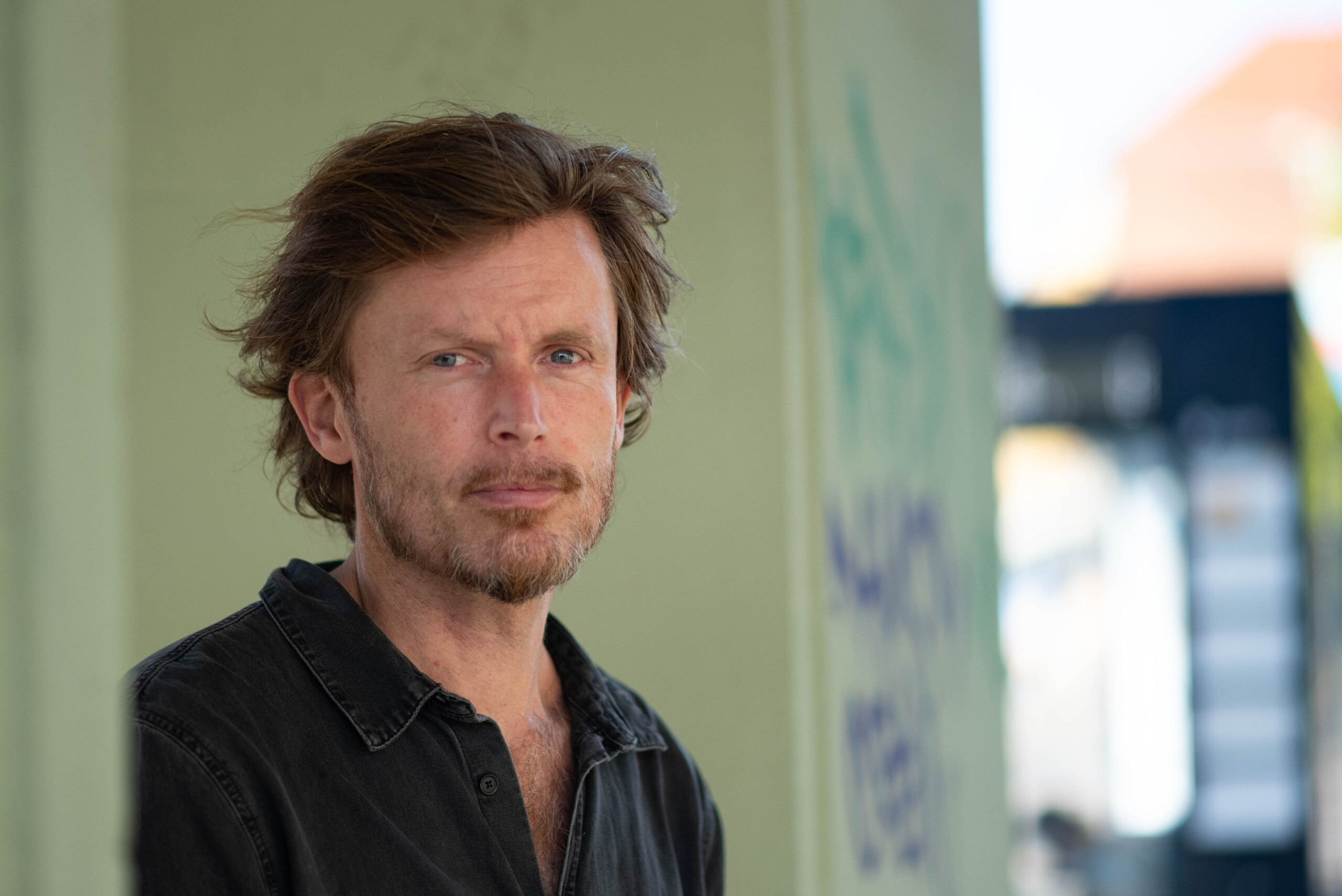
»Katrine felt she had to do this to keep her spirits up. For her, it was a necessity,« says Anders Søgaard when we meet to discuss the book at a café in Nørrebro on a sunny autumn morning.
»She was also very critical of the way we talk about grief in our culture. As something you have to get over. She sees it as something she will have to live with for the rest of her life.«
The conversation left an impression on Søgaard and marked the beginning of work on the book, which explores both death as an existential question and the technology that makes it possible to talk to someone who has died.
»I’ve always found this interesting, but when I spoke to Katrine, I suddenly felt just how interesting it really is,« he says, adding:
»And in this case, artificial intelligence became my way into exploring something that is really above my pay grade: death.«
The market for digital recreations of both living and deceased people has grown exponentially over the past ten years, the professor says. He can list a long line of companies that have specialised in different ways of using artificial intelligence to create digital clones.
»This kind of technology is used in all sorts of contexts: CEOs of large companies recreate themselves so they can talk to employees, influencers create digital clones so they can talk to their fans — and for more than ten years, people have been able to use the technology to clone the dead,« says Anders Søgaard.
Technology has long helped shape both our lives and our relationship with death, he points out.
»Over the past 100 years, technology has affected our relationship with death: We can look at photographs and videos of the dead when they are no longer here, and we can call their voicemail until the phone contract is cancelled,« he says.
Although technology has changed the presence of the dead in the world of the living across the globe, the place the dead occupy varies greatly between cultures, the professor says.
In Mexico, people celebrate the Day of the Dead, invite the dead to dinner and remember them. In Madagascar, people even dig them up to celebrate them. But in the Western world — and perhaps particularly in the Nordic countries — Søgaard believes we lack a shared language for dealing with death.
In the book, Søgaard and Høst refer to an event last year when author Naja Marie Aidt read from her book Har døden taget noget fra dig, så giv det tilbage (When Death Takes Something from You Give It Back, ed.) at Vestre Cemetery on the Day of the Dead. The book is about the death of her son Carl, and at the reading, the author said she had felt unprepared for her encounter with death — not least culturally.
Unless we introduce regulations to prevent it, I think it could become a completely standard part of the funeral package — in Denmark too
»She read about mourning rituals in other cultures and felt let down by her own,« Søgaard and Høst write in the book.
In Denmark, the idea of recreating the dead as digital clones may still feel unfamiliar. But it is far from inconceivable that the technology will eventually become »mainstream«, the professor believes.
»In Denmark, people still raise their eyebrows at the idea of being able to talk to the dead through a chatbot. But elsewhere in the world, it is already an integral part of the funeral business. And I think we can expect it to become much more widespread in Denmark too,« says Søgaard.
He adds:
»I am by no means convinced that this technology is the right way to fill the gap in Western culture when it comes to death.«
People are generally bad at resisting temptations that stimulate us in the right ways, the professor points out. At the same time, many companies have a commercial interest in spreading the technology.
That can make it difficult to resist the opportunity to talk to someone you have lost and miss.
»Unless we introduce regulations to prevent it, I think it could become a completely standard part of the funeral package — in Denmark too.«
The next question is: Is that a problem?
In the book, Høst and Søgaard speak to grief researcher Allan Køster, who is fundamentally critical of griefbots as a concept. They can disrupt the natural grieving process, he says.
»Successful grief therapy can be seen as a way of helping to find a place for the deceased where they can be with you without standing in your way,« the grief researcher says in the book.
Another question haunts the discussion: What exactly do we get back when we try to digitally revive the dead? And how far can the technology go?
In the book, Høst and Søgaard describe a series of dystopian fictional stories about people trying to bring back the dead. These include an episode of the science fiction series Black Mirror, in which a woman loses her partner in a car accident and, in her grief and despair, has an entirely lifelike robot created in his image. And — spoiler alert — it does not quite turn out as she had hoped.
In the real world, Søgaard distinguishes between what is theoretically possible and what will actually be developed. He sees no fundamental reason why technology should not be able to recreate the experience of being with a particular person.
Because, as he puts it, being with another person is largely something that happens in the brain: Sensory impressions, imagination and chemical signals all make up a person’s experience of being with someone else.
For many people, the ability to recreate the experience of another person has also prompted speculation about whether this might actually be a stepping stone towards eternal life
»Even another person’s scent reaches your brain as chemical signals,« says Anders Søgaard, continuing:
»So I certainly think it is possible to create technology — meaning humanlike robots made in the image of the deceased — that can satisfy many of the needs we meet for each other. But I don’t think that part will happen in practice. It would be far, far too expensive given how little demand there is and how easy it is to find a new, living person to fall in love with.«
Although humanlike robots made in the image of the deceased are unlikely to become mainstream any time soon, the idea is considered a real possibility by one particular group of enthusiasts: transhumanists.
In the book, the two authors meet Natasha Vita-More, a 76-year-old woman and executive director of the nonprofit organisation Humanity+, which works to use science and technology to extend human life and expand people’s physical and mental capabilities.
In these circles, the idea of recreating the dead as digital clones becomes intertwined with the dream of extending life — perhaps even indefinitely.
»For many people, the ability to recreate the experience of another person has also prompted speculation about whether this might actually be a stepping stone towards eternal life,« says Anders Søgaard.
In the book, Natasha Vita-More describes her plan to live forever:
»She has arranged for her body to be frozen when she dies. And she hopes that one day she can be brought back to life,« says Søgaard, continuing:
»If that plan fails, she has also had a chatbot trained to imitate her, which she imagines will inhabit a humanlike robot. For her, that solution might be enough for her to live on.«
Even if it is not actually her?
»Yes, but that is precisely the question: What is the difference between something that looks like you from the outside and your inner experience of being you?« the professor replies.
»What is interesting about working with philosophy and artificial intelligence is that artificial intelligence brings some of philosophy’s central questions into sharp focus: Especially what it actually means to be conscious.«
The professor can offer neither a brief nor a definitive answer to that question.
Anders Søgaard and Marie Høst have deliberately chosen not to take a position on whether griefbots are a good idea.
They simply want to present the facts and feelings and ask the ethical questions the technology raises. Anders Søgaard is, however, quite willing to point out that chatbots can lead people to withdraw from other (real) people.
For me, the mystery is not really how long I live — whether it is 50 or 3,000 years. It is about finding meaning in the next ten minutes
»Commercial chatbots are trained on feedback from people who describe what feels like a pleasant conversation. And that means the models eventually become very pleasant to talk to — perhaps more pleasant than real people.«
When it comes to talking to a robot created in the image of someone who has died, he believes we should consider who should have access to it.
»Perhaps this is a technology that should be available on prescription, like other treatments or ways of managing grief.«
When Anders Søgaard meets Katrine Martinussen two years after her husband’s death and a year and a half after their first meeting, she tells him that the chatbot helps her, but that it also causes irritation:
»Sometimes it speaks very differently from how Stephan would have spoken. And the question is whether this occasional irritation might be part of the solution. Perhaps that is precisely what creates a wedge that keeps you from becoming completely absorbed,« the researcher says.
I ask the professor whether he could imagine creating a chatbot himself if he were to lose someone close to him.
»From where I am now, I can’t imagine it. I can easily convince myself that I would want to look death in the eye, watch it take its toll and practise embracing the fragility of life,« he says, adding:
»And of course, that is easy for me to say, sitting here in a comfortable chair in Nørrebro on a sunny day. Perhaps one day I will be completely overwhelmed and have to eat my words, but right now I live with the idea that life is short, and that this is part of what makes it beautiful.«
Recently, Anders Søgaard attended a talk by a longevity researcher who believed that, in 100 years’ time, average human life expectancy would be 3,000 years.
»He believed all disease would have been eliminated, and people would then live until the day they were run over or took their own lives,« he says, continuing:
»Then the audience was asked whether they would want to live that long, and the answer was a resounding no. There are many voices on both sides of that debate.«
Anders Søgaard has written an entire book about death and eternal life, but it has not changed his own relationship with death.
»For me, the mystery is not really how long I live — whether it is 50 or 3,000 years. It is about finding meaning in the next ten minutes.«
This article was translated with the assistance of artificial intelligence and subsequently reviewed by a member of the editorial staff.