



Universitetsavisen
Nørregade 10
1165 København K
Tlf: 35 32 28 98 (mon-thurs)
E-mail: uni-avis@adm.ku.dk
—
Science
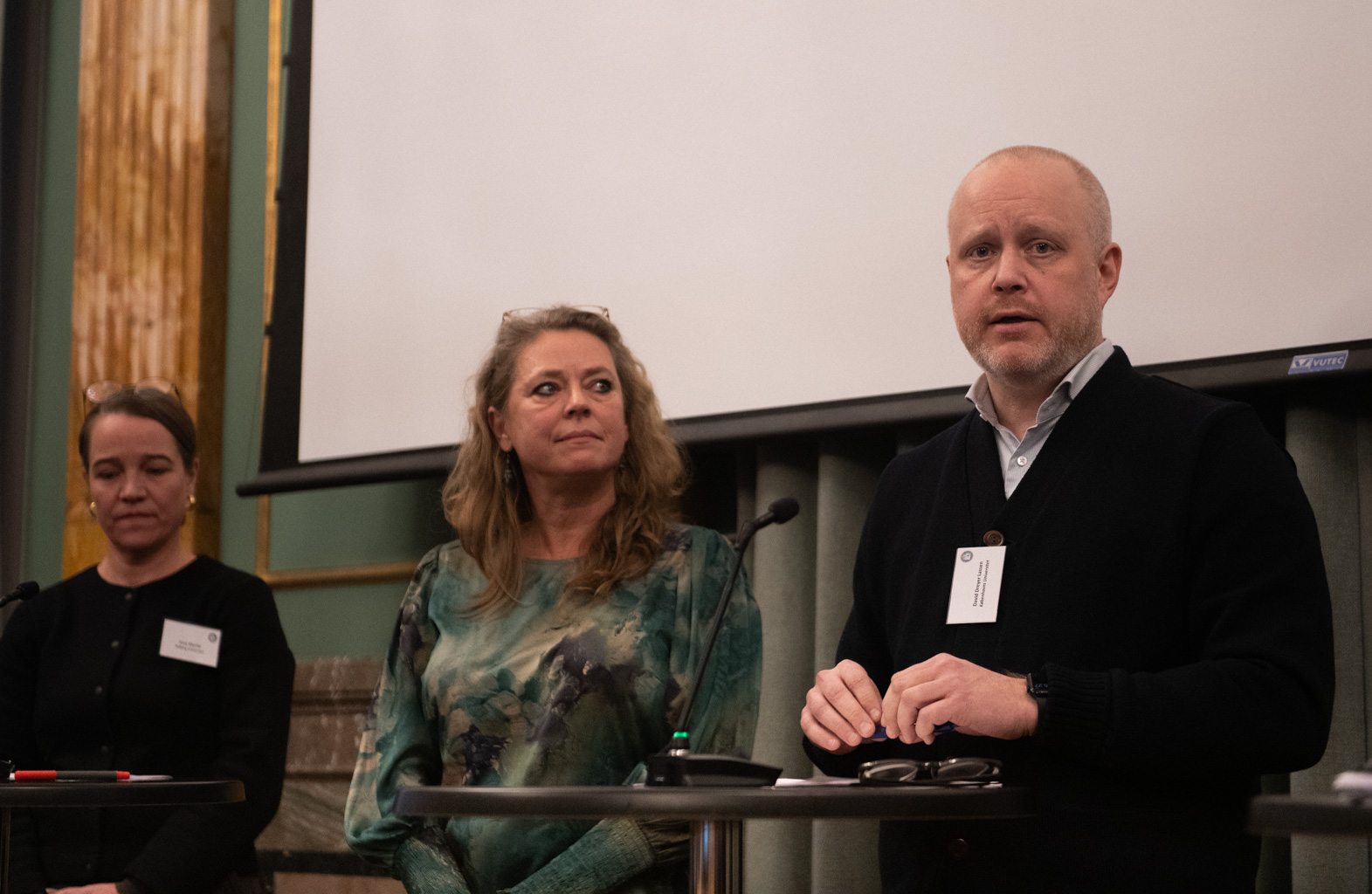
State of affairs — At the Royal Danish Academy, David Dreyer Lassen spoke of fierce competition, an increase in fixed-term appointments, and the need for new criteria for recruitment of academics.
How should universities select researchers for future universities? And what does it actually imply when more researchers are being hired on fixed-term contracts?
These, and other, questions were discussed 28 January at the Royal Danish Academy of Sciences and Letters for the ‘Future Researchers’ conference. People were there from throughout the Danish university sector.
Rector of the University of Copenhagen (UCPH) David Dreyer Lassen was there also, and he was interviewed by the University Post after the conference. He talked about what he thinks should matter when future researchers are to be recruited, why there are downsides to both the traditional and the emerging university ideals, and why he doesn’t believe Danish universities — unlike universities abroad — can use permanent tenure for acacemic employment.
An important shift is already underway at Danish universities, according to David Dreyer Lassen. Though the process is still ongoing, hiring committees work less mechanically and much more »holistically« nowadays, as the rector puts it.
There has been a move away from simpler metrics like publication numbers and journals’ impact factor in recruitment. Universities are more likely to assess what a researcher has actually contributed — and whether the work has had a real impact on a field, the rector says:
»If you’ve written one or two articles that have really shifted a field, it may be better than writing 20 articles that merely made incremental changes.«
READ ALSO: Lecturers in limbo: »There’s no job category for people like us«
Merit assessment criteria have been used for several years at UCPH that also include skills in areas like teaching, and in societal impact.
The holistic approach is also reflected in the international initiative CoARA (Coalition for Advancing Research Assessment), which seeks to challenge traditional benchmarks for what counts as good research. All Danish universities have signed up to the initiative.
The rector emphasises, however, that holistic evaluation should never become a gateway for arbitrary decisions in researcher recruitment.
»It mustn’t become a shortcut to nepotism,« he says.
Another concern raised in the conference’s discussion on researcher recruitment was gender.
Here, the UCPH rector supports a principle that was mentioned on stage: If two candidates are closely matched, diversity can reasonably be the deciding factor — for example, by selecting a woman in a male-dominated field, or vice versa.
READ ALSO: Why some degrees only attract women — and others only men
»This is fundamentally a sound principle,« he says.
The rector believes, however, that the concept of diversity should be broadened to include more than the gender category. It could include international experience, different research traditions, or just the need for fresh perspectives in a research setting.
The number of researchers in fixed-term contracted positions has risen at Danish universities in recent years.
This has led to a loss of job security among early-career researchers. Pursuing a research career in Denmark in a fixed-term positions implies more uncertainty.
Our strategy must not be a hope for more core funding in five years time
Rector David Dreyer Lassen
David Dreyer Lassen acknowledges this concern.
»The combination of more funding and more internationalisation means that recruitment draws from a much larger pool — and that increases the competition,« says the rector.
READ ALSO: 130 testimonies from researchers reveal widespread fear and reprisals at Danish universities
Many in the research community have for a long time called for more government-provided basic funding to counteract this. But according to David Dreyer Lassen, universities should avoid letting this dictate their approach.
»Our strategy should not be based on a hope for more basic funding in five years time. We must shape the university based on what we have now,« he says.
Teaching is an important factor in this debate, the rector stresses. Universities are committed to research-based education — and this means that teachers must also be active researchers. This puts a built-in limit on how many researchers a university like UCPH can employ.
And external funding doesn’t solve the basic funding problem. In some cases it may even worsen it, he says, as universities often have to co-fund externally financed projects.
A research career in Denmark is precarious. And just how precarious it is was underlined by recent dismissals at the Faculty of Science at the University of Copenhagen.
Just before Christmas, the university had to lay off 66 employees to counteract what had become an annual DKK 100 million deficit.
It was not the first round of layoffs to hit the faculty and not the first round to hit the University of Copenhagen as a whole. Staff representatives and a former UCPH researcher have expressed concerns in the University Post that the dismissals would damage the university’s reputation.
READ ALSO: Layoffs shake trust in University of Copenhagen — researcher warns international colleagues
David Dreyer Lassen acknowledges that news of the layoffs will spread abroad and potentially affect the university’s ability to attract top researchers.
»Are we missing out on some of the best because of that? Maybe we are. But that doesn’t change the fact that we had to do what we did,« he says.
In many other European countries, research positions are more secure, and the tenured positions abroad naturally lead to permanent employment. But that’s not how it works in Denmark.
This is due to the general conditions of the Danish labour market, and for that reason David Dreyer Lassen believes it is unrealistic to imagine the rules will be changed.
»I think it’s a bit of a futile discussion, because I don’t believe we can get that changed,« he says.
According to the rector, UCPH is attempting to create tenure-like arrangements similar to those in Germany and the US — but he also acknowledges that it will never be exactly the same.
This, in his view, means that UCPH will face a major challenge in securing top research talent in the coming years. The university is both bound by Danish regulations and dependent on an international research community.
And that is precisely why, he says, the work of future recruitment and job structures is »not something we solve in an afternoon« — neither at UCPH nor in the Royal Danish Academy of Sciences and Letters.