




Universitetsavisen
Nørregade 10
1165 København K
Tlf: 35 32 28 98 (mon-thurs)
E-mail: uni-avis@adm.ku.dk
—
Education
Block politics — SCIENCE’s teaching blocks are to be shortened from eight weeks to seven. Two union representatives fear the impact on teaching and criticise insufficient staff involvement. The associate dean defends the change but acknowledges some loss of quality.
It should be easier for students at the University of Copenhagen to take a course at another faculty without classes and exams clashing.
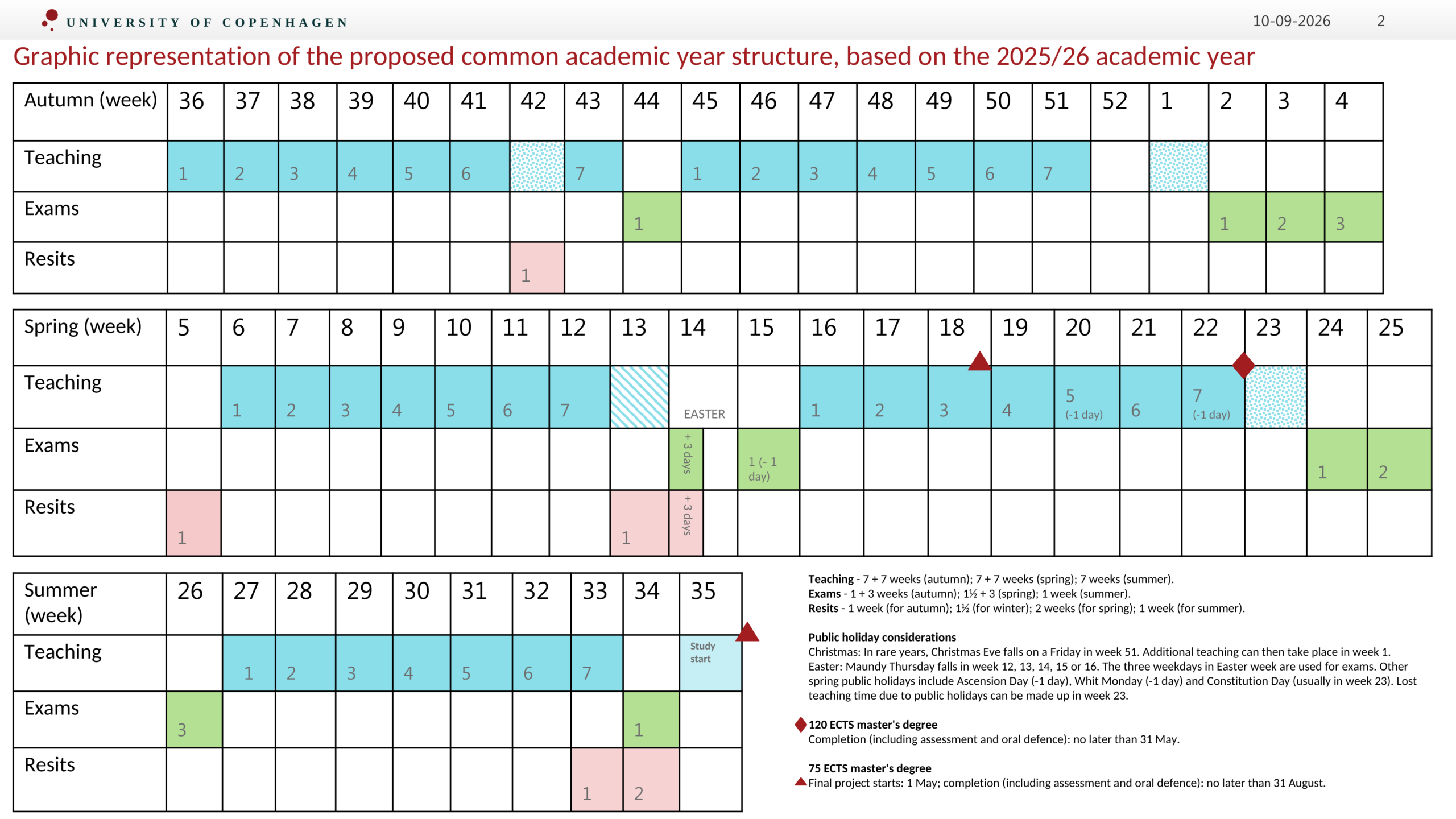
University management has therefore adopted a common structure for the academic year, designed to bring the university’s block-based and semester-based courses into the same calendar.
In practice, it will be impossible to squeeze in the same syllabus because our teaching is already very intensive
Peter W. Thulstrup, associate professor at the Department of Chemistry, senior union representative and member of UCPH’s General Collaboration Committee
At the Faculty of Science, SCIENCE, this means that the academic year will be divided into blocks with seven regular teaching weeks instead of eight.
Teaching staff at the faculty fear, however, that the change will mean fewer teaching hours and less course content.
»What will happen in practice is that the amount of material taught will be cut,« says Jakob R. Winther, a professor at the Department of Biology, a union representative and a member of the department’s collaboration committee.
»If teaching continues with the same number of hours per week, seven weeks instead of eight will mean 12.5 per cent fewer teaching hours,« he says.
Peter W. Thulstrup, an associate professor at the Department of Chemistry, a senior union representative and a member of UCPH’s General Collaboration Committee, points out that courses must still carry the same number of ECTS credits.
»In practice, it will be impossible to squeeze in the same syllabus because our teaching is already very intensive,« he says.
According to Peter W. Thulstrup, courses involving experimental work often have 10–12 teaching hours a week. With two courses running in parallel, students can therefore have 20–24 hours of classes before spending any time on preparation and other coursework.
»This type of teaching takes time. It is not as though we can simply add extra teaching days or more contact hours,« says Peter W. Thulstrup.
Concerns about teaching quality were also raised during discussions of the new structure. An appendix to the papers presented to UCPH’s General Collaboration Committee describes a wish to retain eight teaching weeks, as reducing them to seven was considered likely to lower quality.
That request was not accommodated. According to the appendix, retaining eight weeks would, among other things, leave less time for exams and make it impossible to finish all autumn teaching before Christmas.
Andreas de Neergaard, Associate Dean for Education at SCIENCE, says the faculty has paid close attention to the risk of losing teaching time while working on the new academic year structure.
»If this had meant shortening every block at SCIENCE by a week, I would consider that too high an academic price to pay,« he says.
According to the associate dean, the new structure’s negative impact is considerably smaller than the two academics and union representatives suggest.
He points out that the new structure includes four potential supplementary weeks. One falls during the autumn break, which SCIENCE wants to retain, partly out of consideration for staff and students with children. He believes the other three can be used to retain eight weeks of teaching in blocks 2, 3 and 4.
I am absolutely convinced that no one will receive a poorer education
Andreas de Neergaard, Associate Dean for Education at SCIENCE
»So we are not losing four weeks. In reality, we are losing one,« he says.
The supplementary weeks are not, however, official teaching weeks, although they can be used for teaching and other academic activities. According to the supporting documents, they can compensate for the eighth week »to some extent«.
Andreas de Neergaard acknowledges that the shorter teaching period in the first block is a step backwards.
»Academically, it is worse than what we have now,« he says.
He cannot yet say whether the new structure will mean a reduced syllabus.
Despite the shorter teaching period, however, he does not expect the overall academic standard of the degree programmes to fall.
»I am absolutely convinced that no one will receive a poorer education,« the associate dean says.
From his perspective as a lecturer, Peter W. Thulstrup is uncertain how much the supplementary weeks can help, precisely because they are not specifically set aside for teaching.
Jakob R. Winther also points to the possibility of teaching clashing with resit exams during these weeks.
The documents describing the new model support this latter concern. In the calendar illustrating the structure, week 13 is both a supplementary week and part of a resit exam period.
Peter W. Thulstrup supports the ambition of a more integrated university where students can more easily take courses across faculties. But he questions whether the benefits justify the consequences.
So does Jakob R. Winther, who wants a basis for assessing how many students will benefit from the change.
»It would be very interesting to know how many people this benefits compared with how many it inconveniences,« he says.
I simply find it very strange that the people affected are not consulted more
Jakob R. Winther, professor at the Department of Biology, union representative and member of the department’s collaboration committee
According to Andreas de Neergaard, around 7.5 per cent of SCIENCE students’ study activity, measured in full-time equivalent student years, takes place at other faculties. This includes joint degree programmes, courses that form part of degree programmes, and electives.
The associate dean says this has been the faculty’s main reason for wanting a common structure.
Jakob R. Winther, however, believes that simpler and cheaper administration has taken priority.
»Administration is being prioritised over teaching,« he says, adding:
»And although it may benefit a small number of students, almost every course at SCIENCE will pay the price.«
Administrative savings are one of the stated aims of the change, which is an initiative under UCPH’s administration reform.
Andreas de Neergaard rejects the suggestion that the academic price is too high. Since he believes the problem can be confined to the first block, he considers the benefits of a common calendar to outweigh the disadvantages.
»It was the best compromise we could reach to achieve a common structure for the whole university,« he says.
The two academics also criticise management for failing to give the academic communities affected sufficient opportunity to influence the decision.
»I simply find it very strange that the people affected are not consulted more,« says Jakob R. Winther.
According to the briefing paper, the model was discussed in spring 2026 by several monitoring and reference groups established as part of the administration reform, including a monitoring group under the General Collaboration Committee (HSU).
Andreas de Neergaard also says he discussed the model several times with SCIENCE’s deputy heads of department for education. According to him, it was also considered at a meeting of heads of studies and through a written consultation with them. He believes the relevant academic perspectives were represented in those discussions.
Jakob R. Winther, however, argues that discussions with those responsible for education do not in themselves ensure that staff have a say. He believes the academic communities affected should have had greater opportunity to influence the decision.
Peter W. Thulstrup also maintains that the implications for teaching should have been discussed more widely within the academic communities. Among other things, he would have liked the matter to have been considered by SCIENCE’s Academic Council.
When HSU itself considered the matter on 17 September, university management had already adopted the structure on 19 August. According to the briefing paper, HSU was to be informed and invited to highlight issues from a staff perspective, particularly regarding implementation.
Peter W. Thulstrup fears that introducing the new academic year structure will entail a great deal of work to adapt courses and programme curricula.
»There is a huge amount of administrative work involved in adapting these courses and the teaching they involve,« he says.
UCPH’s supporting documents describe implementation as a substantial undertaking that will require resources from both academic communities and the administration.
Management is increasingly making decisions without meaningful staff involvement
Jakob R. Winther, professor at the Department of Biology, union representative and member of the department’s collaboration committee
Andreas de Neergaard, however, expects more limited changes at SCIENCE. He does not expect the restructuring in itself to require changes to the degree programmes’ learning outcomes. In his view, many courses will be able to adapt by changing their practical organisation.
He acknowledges, however, that this will depend on what emerges from the work on individual courses. Course coordinators and study boards will have to decide whether any changes to course learning outcomes are needed.
The academic year structure is expected to be introduced in 2028 alongside the new degree formats under the master’s degree reform. The timing has not yet been finalised, however. According to the supporting documents, the scale of the preparations may mean postponing implementation until 2029.
Jakob R. Winther sees the case as the latest example of a trend in which university management makes major decisions without sufficiently involving staff:
»Management is increasingly making decisions without meaningful staff involvement. This has major consequences for both students and teaching staff, and ultimately for learning, the working environment and job satisfaction,« the union representative says.