





Universitetsavisen
Nørregade 10
1165 København K
Tlf: 35 32 28 98 (mon-thurs)
E-mail: uni-avis@adm.ku.dk
—
Science
Whale teeth — After an unusually high number of whale strandings since the turn of the year, experts from the Natural History Museum of Denmark have secured the lower jaws and other bones from the enormous animals. They will now be cleaned and catalogued so they can be used for research and become a part of the scientific collection.
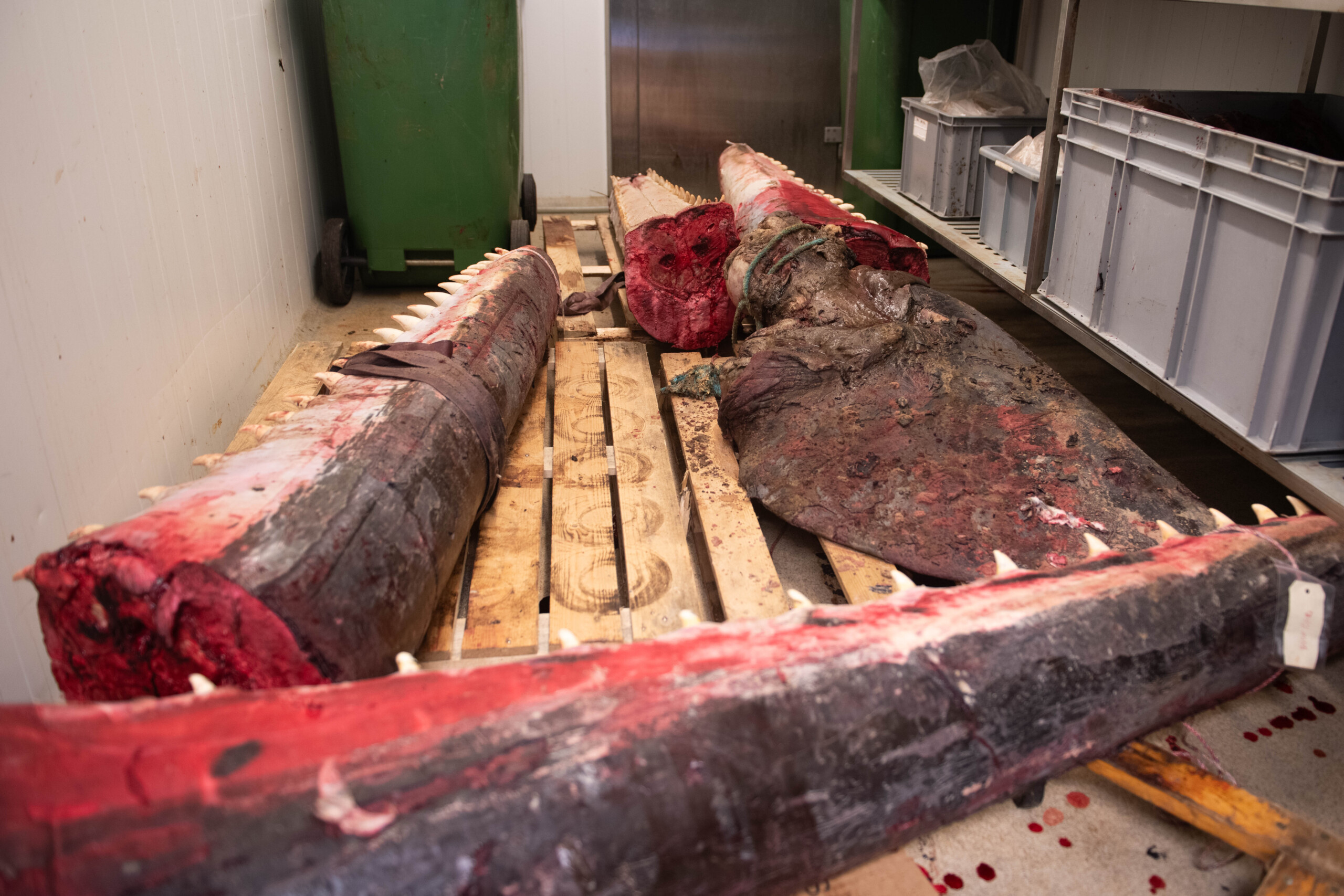
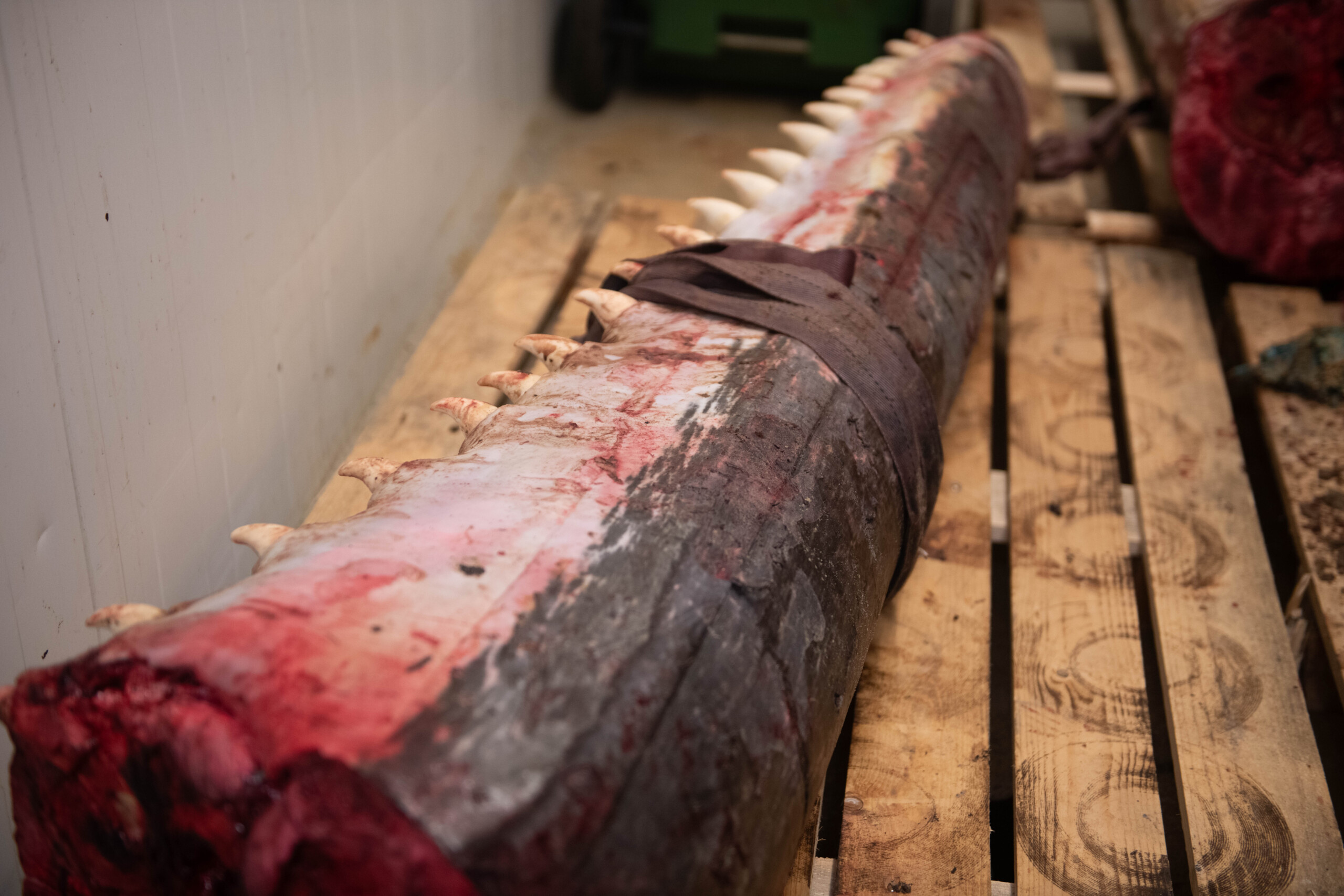
The door to the cold storage swings open. A sweet smell of something, almost rotting, drifts into my nostrils. The faint hint of something that was once alive. On pallets, under the harsh ceiling lighting, four enormous lower jaws from sperm whales, set up like goods in a warehouse.
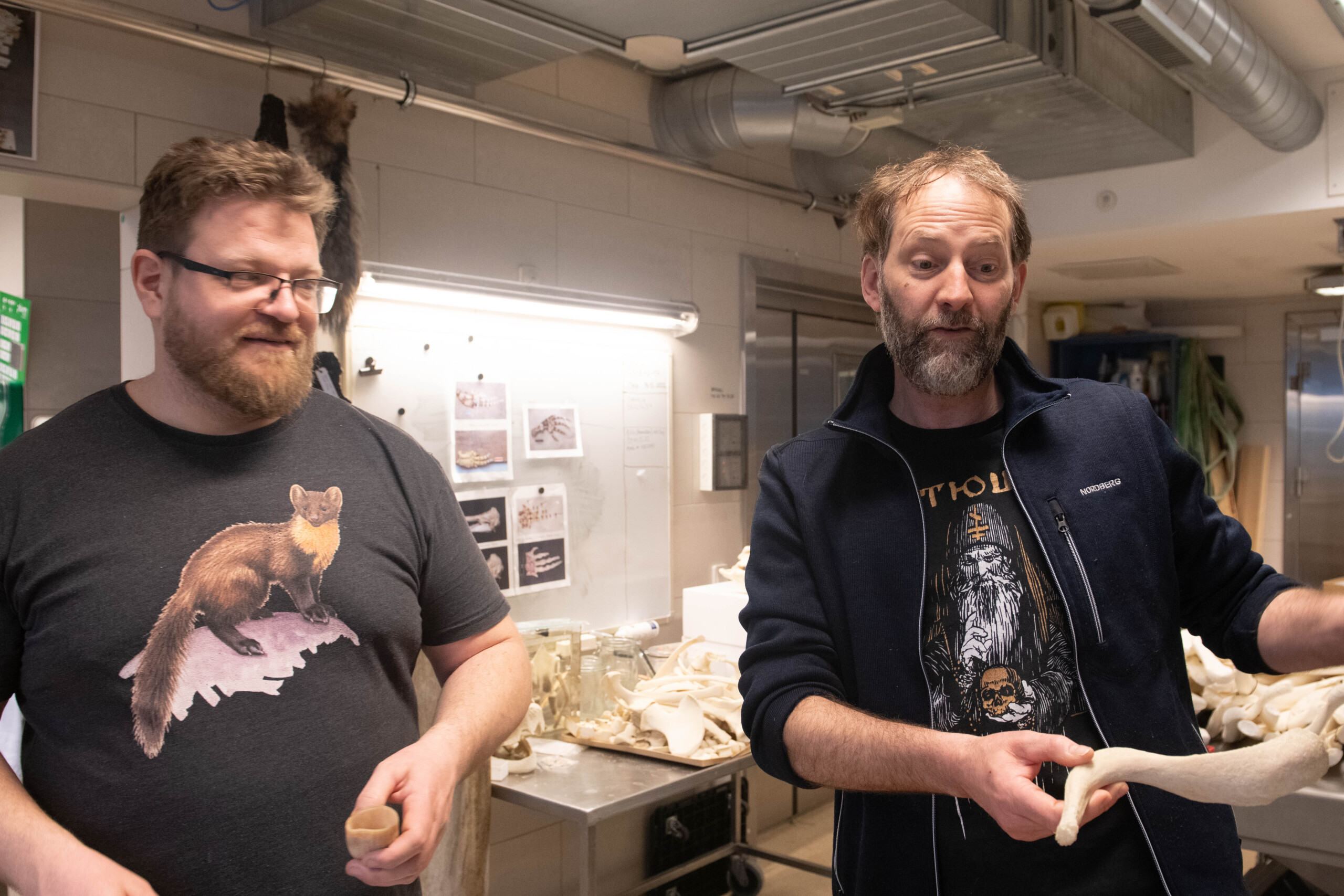
»So there they are,« says biologist and collection assistant at the Natural History Museum of Denmark, Daniel Johansson, nodding towards the floor.
»And there are two more out with the veterinarians in Frederiksberg campus. We’ll pick these up later.«
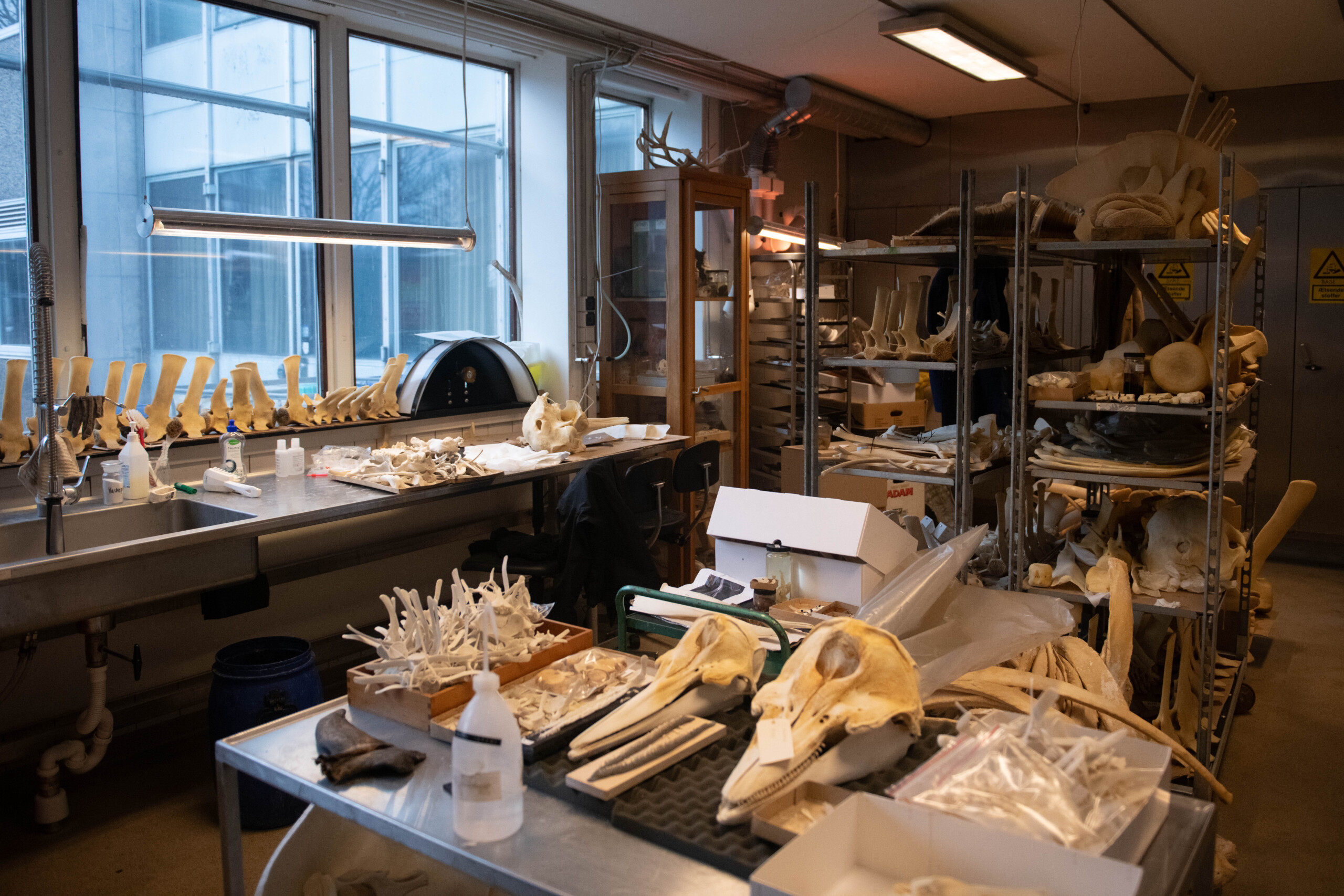
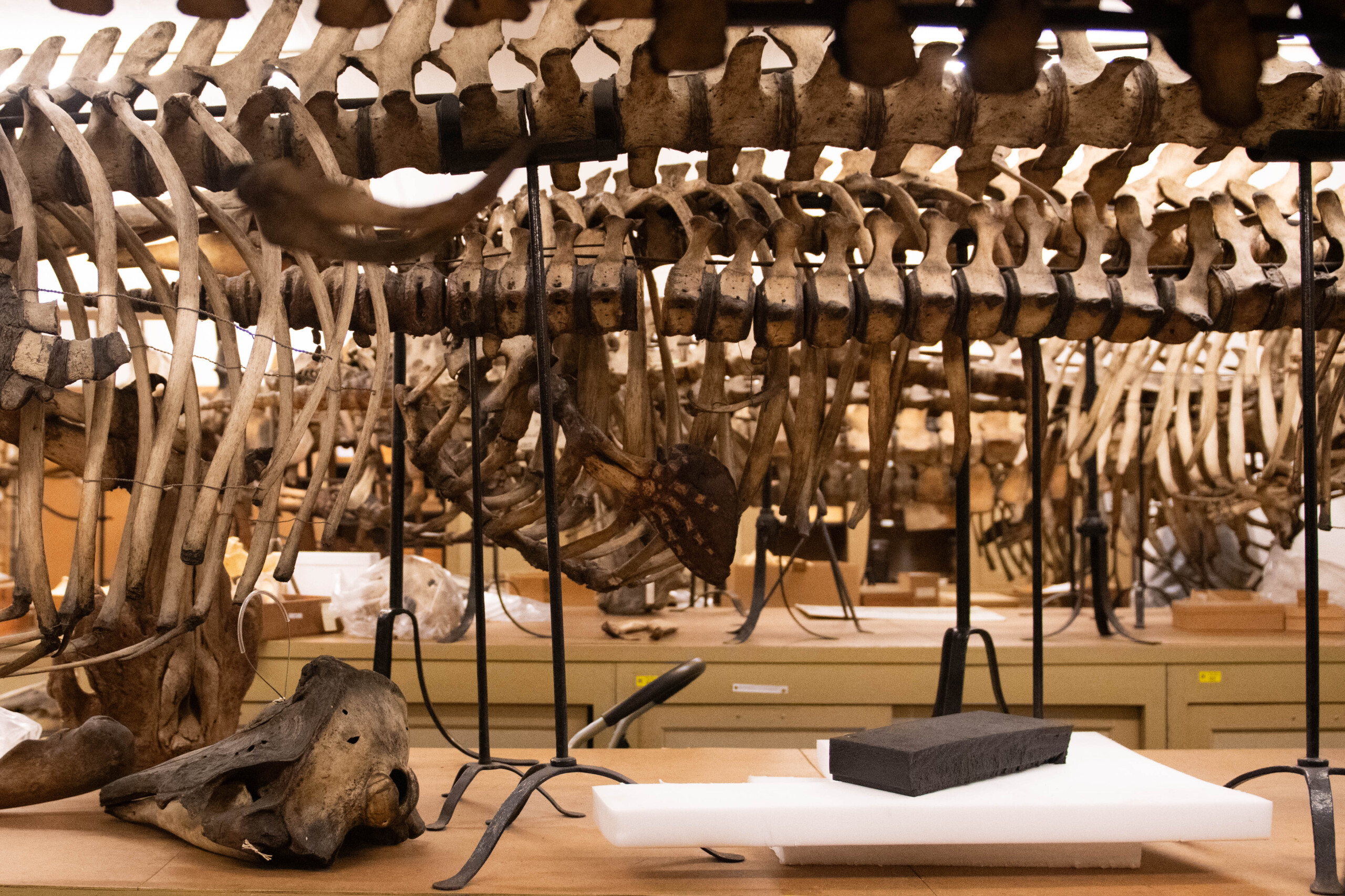
We are in the dissection room at the Natural History Museum of Denmark, where animal bones and teeth are processed, registered, and prepared to become part of the museum’s enormous collection.
Next to the jaws in the freezer is the flipper of a whale and, along the wall, crates with other bone fragments. All parts of what can be recovered from an animal weighing around 25 tonnes washed up on a beach.
This has happened time and time again in recent months.
Eight sperm whales have stranded in Denmark — mainly around the island of Fanø in the Wadden Sea.
Six of the lower jaws have now been secured and they have ended up here at the Natural History Museum of Denmark, which is a unit of the University of Copenhagen (UCPH). They will be used for research and become part of the collection, where they can be preserved for future generations.
Sperm whales normally live in deep waters near the equator, where they dive for squid and navigate using clicking sounds and echolocation.
With the coming of autumn, the male sperm whales head towards the poles for a season of intense feeding. When the waters get warmer, they head back towards the equator, where the largest males get the chance to mate with the females.
But on the return journey from the Arctic, the young males sometimes swim the wrong way. Instead of heading west around the British Isles and out into the Atlantic Ocean, they enter the North Sea, where they become trapped and cannot find their way out.
»The North Sea is like a funnel. And once the whales get in, the water is shallow no matter which direction they turn,« says Daniel Johansson.
Sperm whales are also social animals, so when one whale strands, it calls out to the others, who then follow it. This brings in more massive animals up onto the beaches.
Once a large whale is firmly stranded, there is rarely much that you can do. The shallow waters of the Wadden Sea make it impossible to guide the animals back out to sea.
Researchers therefore have to let them die on the beach, after which they can dissect them to learn more about their biology. A dissection often involves more than 20 different specialists, particularly veterinarians and biologists. But the work is not only about research. It is also about getting there first.
»The first thing that was done was to cut off the lower jaws,« says Daniel Johansson about the work on the whales at one of the strandings.
It was staff from the Danish Nature Agency who removed the jaws to secure the teeth — for fear that someone else might otherwise cut them off.
»We knew that unfortunately it was something that could happen.«
The risk is real. Shortly after it had washed ashore, unknown perpetrators had sawn off the lower jaw of a stranded sperm whale near the Blåvandshuk Lighthouse at the beginning of February.
»They are most likely going for the teeth,« says Daniel Johansson.
»The only thing I know they are used for is tupilaks (small figurines originally from Inuit culture carved from materials such as whale bone or teeth, ed.). Whether someone is trying to sell them, or what they intend to do with them, we do not know,« he says.
But the teeth are also of value to researchers. They can, for example, be used to determine the age of the stranded animals.
Stranded whales are by law government property, and there is significant research value in securing as much of the animals as possible. Every single tooth and every bone contains data.
And that is why the lower jaws are now in cold storage at the Natural History Museum of Denmark.
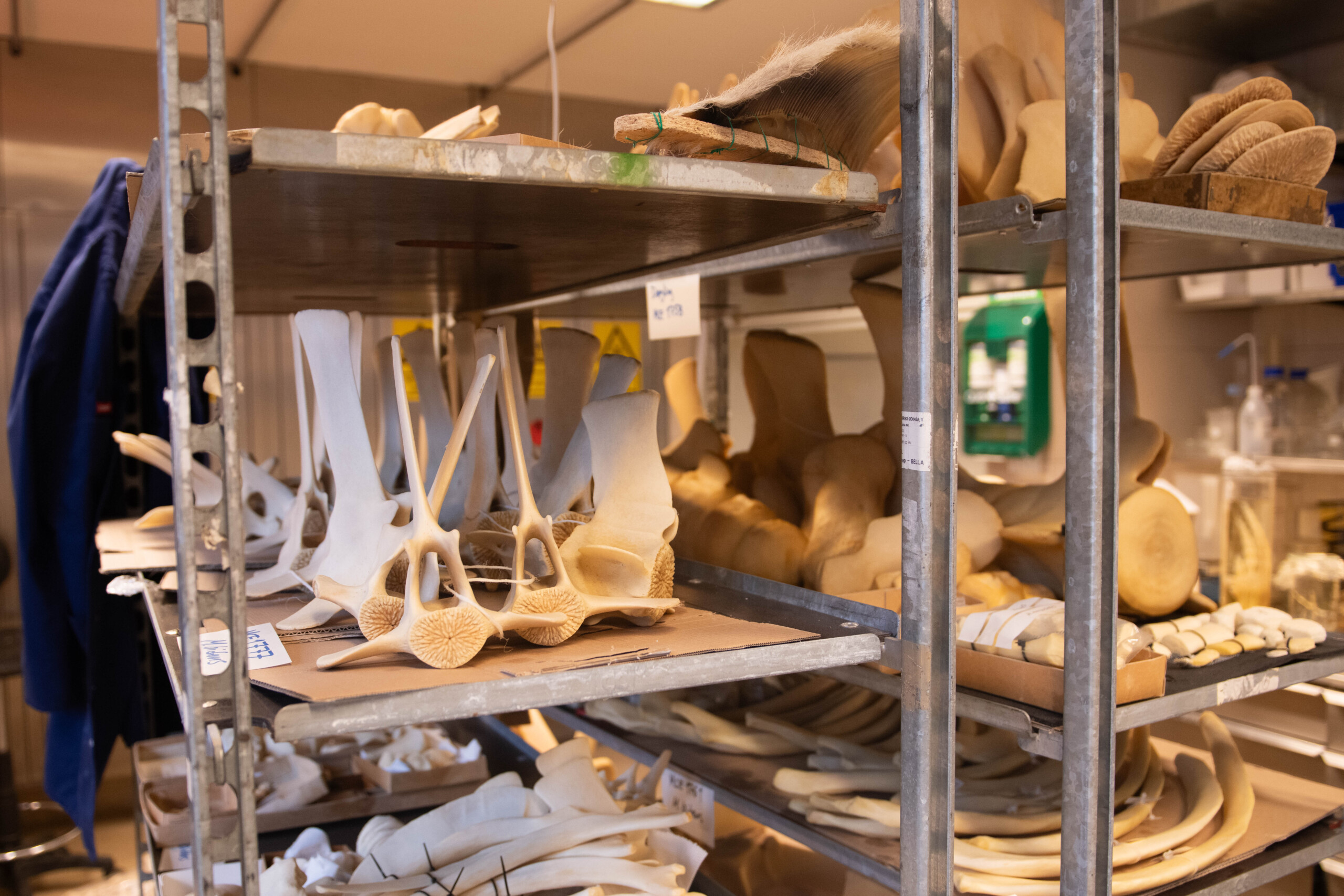
From the cold room, the tour continues into a large space filled with tubs, buckets, tools, bones, and labelling tags.
This is where conservator at the Natural History Museum of Denmark, Mikkel Høegh Post, works to ‘transform’ animals into skeletons that can become part of the collection.
»The most effective and cheapest method is to let it rot,« he says, bluntly.
The method is called maceration. The animal — or parts of it — is placed in water, and then bacteria take care of the rest. The flesh loosens from the bones. The cartilage then follows. Eventually the bones can be lifted out.
»We can accelerate the process by adding heat,« says Mikkel Høegh Post.
»So if we have something where it needs to go a bit faster, we set the temperature at 35—40 degrees.«
But faster is not always better. Especially not when it comes to teeth.
»If it gets warm, they fall out quickly. And then you can’t see which tooth belongs where,« he explains.
In practice, this is the difference between a skeleton that can be reconstructed, and a skeleton that is a puzzle that cannot be put back together.
With the sperm whale jaws, the order is crucial. The teeth look alike, so when they drop out during the process it can be difficult to see exactly whether one tooth was before or after another.
»I’ve found that it’s actually relatively easy to write on the teeth with a marker pen and then remove it again afterwards. So now I mark them, and then they can go ahead and rot and fall out. But now I know the order and how they should fit,« says Mikkel Høegh Post.
It is a kind of systematic craftsmanship, where incorrect numbering or sloppy packaging will mean that an animal cannot be assembled correctly.
»In that sense, the preparatory work is quite extensive and important. Because just chucking something in and letting it rot is easy. But then you end up with an unsolvable puzzle if it hasn’t been registered correctly,« says the conservator.
The hardest thing to clean from the bones is not the flesh, but the fat. It penetrates the pores, and continues to seep out for years, collecting dust and dirt so that even a cleaned skeleton is slowly discoloured.
Around the dissection room are bones that are several years old. They still slowly ‘drip’ small amounts of fat and oil.
The whales’ enormous quantities of blubber and oil, which seep into the bones during the cleaning process, make them among the most difficult skeletons to prepare neatly.
»It’s difficult to plan my work because animals are constantly arriving,« says Mikkel Høegh Post. He describes how the work is interrupted when five wolves from Jutland suddenly arrive, or a young hippopotamus, a crocodile from a zoo, or six lower jaws from stranded sperm whales.
Only a few of the many bones and teeth that are cleaned in the dissection room are displayed in the museum. But they all become part of the collection.
»The public sees only the very tip of the iceberg. But the collection is what we are here for,« says Daniel Johansson.
If the exhibition contains a thousand objects, the collection contains millions. It is here that researchers can follow trends over time, examine variation in populations, and measure the effects of environment, hunting, and pollution.
Using the material, scientists can conduct DNA and isotope analyses, investigate diseases, and measure differences in sex, size, and age. Teeth and skulls are particularly valuable, as they can reveal both diet and age and are crucial for identifying species in several groups of animals.
This is the reason why the museum does not collect only what is immediately relevant. Decades from now, new methods and new questions may turn even an old whale jaw into a key to knowledge that we do not yet realise we are missing.
After the University Post’s visit, Mikkel Høegh Post begins the cleaning process itself: The largest chunks of meat and cartilage are removed, the order of the teeth is marked, and the jaws are submerged in water. After repeated water changes, heating, and scrubbing, the bones are dried before finally finding their permanent place in the collection.
This article was first written in Danish and published on 4 March 2026. It has been translated into English and post-edited by Mike Young.