




Universitetsavisen
Nørregade 10
1165 København K
Tlf: 35 32 28 98 (mon-thurs)
E-mail: uni-avis@adm.ku.dk
—
Science
Hidden treasures — A research project between the University of Copenhagen and the National Museum of Denmark has opened up ancient cuneiform tablets to the public, bringing more than 4,000 years of history etched in clay back to life.
Down a research corridor in one of the far corners of the Department of Cross-Cultural and Regional Studies (ToRS), there is a small enclosed room.
The space is climate-controlled and requires special access, because behind the glass walls lie valuable artifacts from some of the world’s ancient civilizations.
Among them is what Uniavisen has come to take a closer look at today:
A collection of clay tablets with cuneiform writing from Mesopotamia — a collective term for cultures located in areas we today know as Turkey, Iraq, and Syria, dating back to 3200 BCE.
For four
The reason for today’s visit is that the project has now reached its final goal: the collection has been digitized, and anyone interested in ancient cuneiform can now explore it online via the Cuneiform Digital Library Initiative. The collection has also been published in book form.
»It has been really exciting that we’ve had the opportunity to examine the collection as a whole. Previously, it was mainly specialists with specific interests who studied small selections of the texts — never the entire collection,« says Troels Pank Arbøll, Associate Professor of Assyriology at the University of Copenhagen, who has worked on the project together with six other researchers.
A receipt is not exactly mind-blowing on its own, but when we gather a large number of texts like this, a bigger picture emerges
Troels Pank Arbøll, Associate Professor, Assyriology
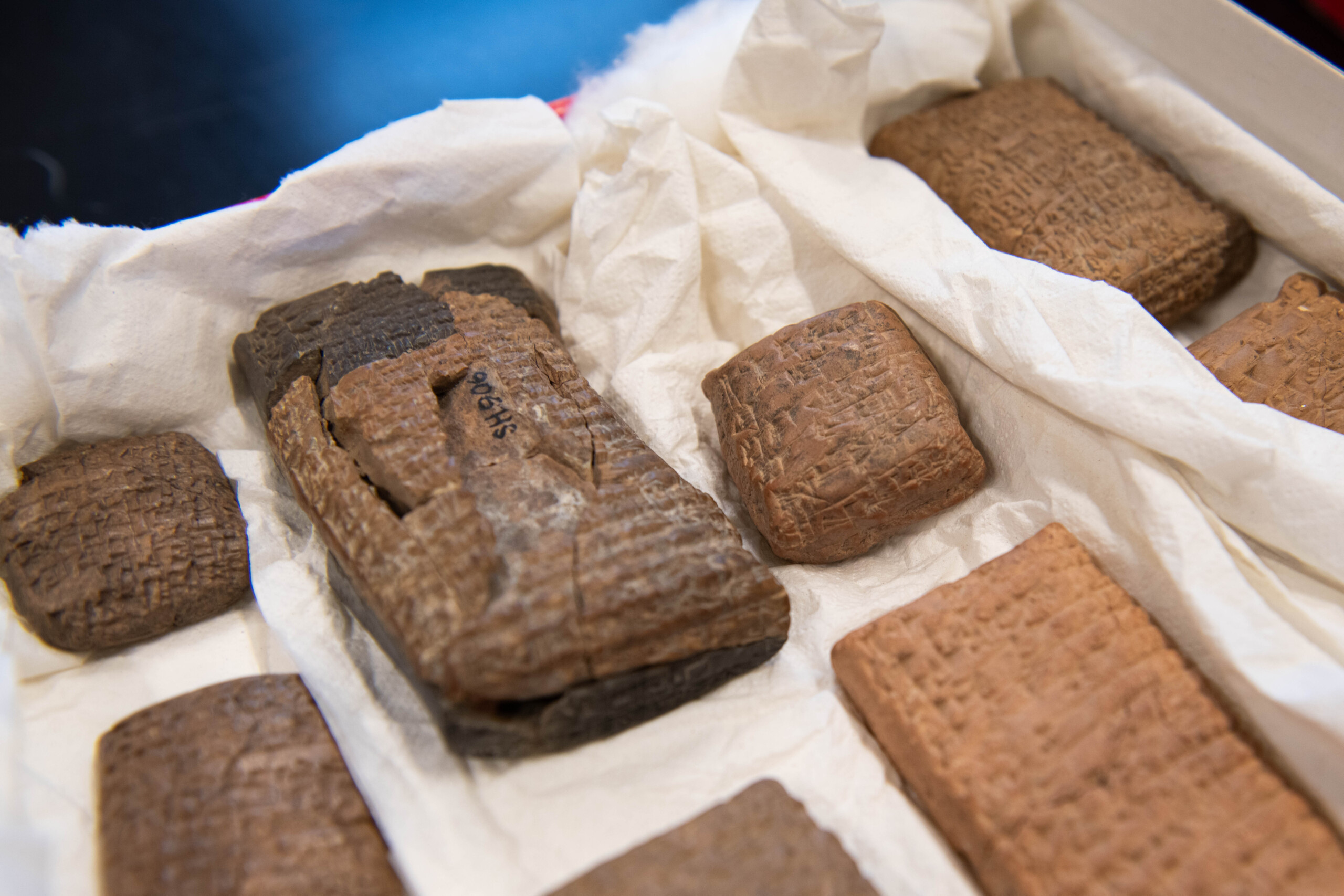
The National Museum of Denmark’s cuneiform collection consists of 241 inscribed objects from a range of different periods, discovered in Iraq, Syria, and Iran. Some are around 4,500 years old, and they vary widely in type — from medical texts and magical incantations to simple receipts.
»A receipt is not exactly mind-blowing on its own, but when we gather a large number of texts like this, a bigger picture emerges. That allows us to carry out quantitative analyses that are quite fascinating. You gain very advanced insights into the economic and cultural structures of these societies,« he explains.
I’m not sure what I had expected. Still, I feel slightly underwhelmed when Troels Pank Arbøll brings out the valuable clay tablets.
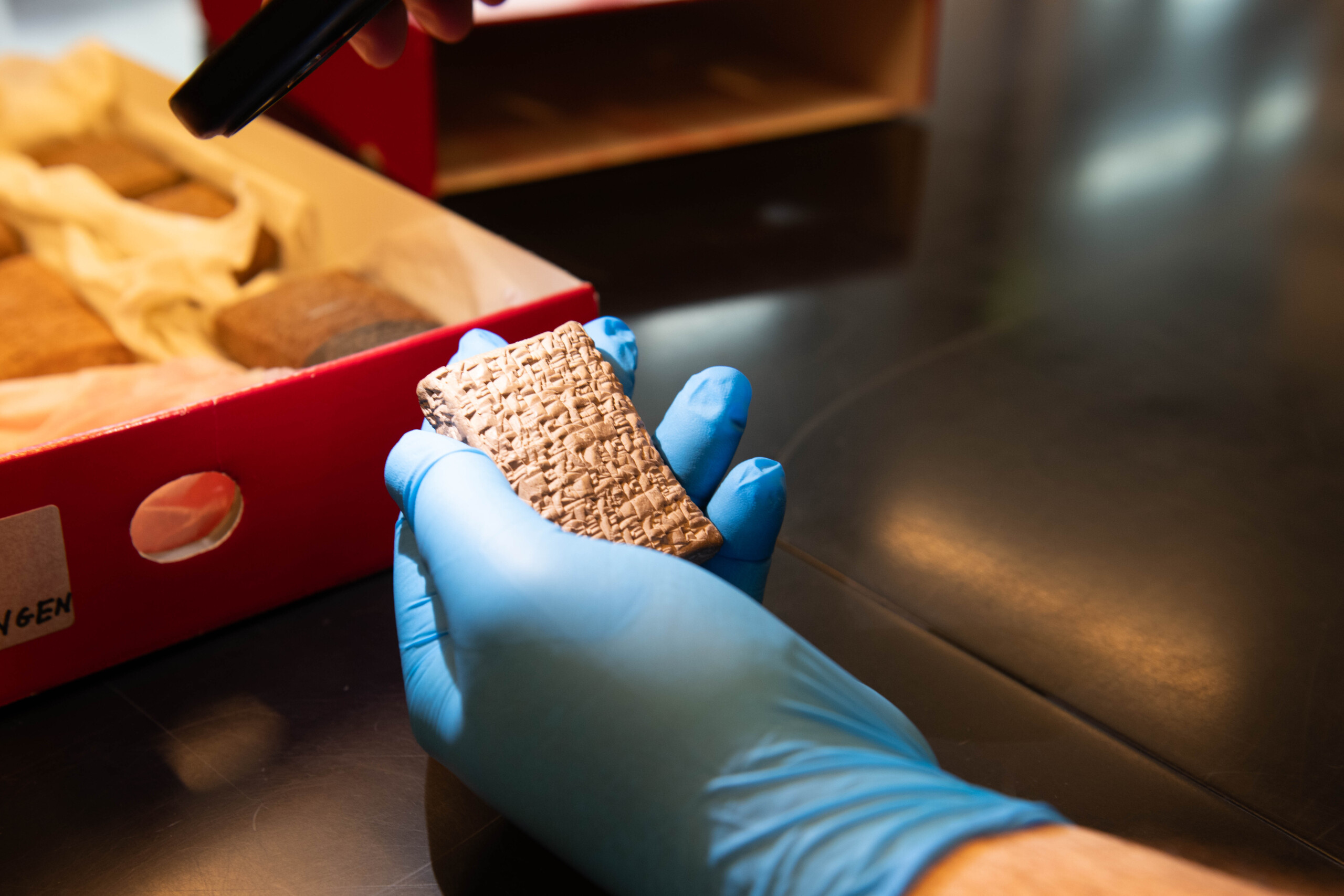
They are quite small — no larger than a modern iPhone — and if you didn’t know better, you might think they were ordinary stones with random markings, like something you might stumble upon along Denmark’s west coast.
The associate professor laughs when I mention that the tablets are smaller than I had imagined.
Read also: He taught himself ‘Elvish’ as a child. Now he is to solve an ancient enigma in Mexico
»Most people think they are huge tablets, but in many cases they’re really not bigger than this,« he says.
Their size does nothing to diminish his enthusiasm, which is evident as he recounts the story behind the small objects.
»Cuneiform — along with hieroglyphs — is the world’s earliest writing system. It was used across different languages from around 3200 BCE until roughly 80 CE. That’s a span of more than 3,000 years, which makes tablets like these a vast historical laboratory.«
Some of the tablets are small, solid pieces of clay with inscriptions. Others are assembled like complex puzzles — tablets that broke in antiquity and were later reconstructed and glued together by conservators after excavation, Arbøll explains.
To preserve them, the tablets have been fired and hardened in modern times. This makes them relatively robust, but they can still break occasionally.
»I’ve never damaged anything myself, but I’ve heard horror stories from abroad about tablets breaking while a researcher was holding them. Some call it ‘the crack of doom’ — when an internal, invisible fracture suddenly causes the tablet to split in two,« he says.
When that happens — and it does from time to time — there is no alternative but to have a conservator glue it back together.
»There will always be a risk in handling them. In principle, it might be better to leave them untouched. But if we want to conduct research, teach, and communicate knowledge, we have to make a judgment about when it’s worth it.«
It takes training and a keen eye to decipher what the many small markings are trying to convey. When reading cuneiform, scholars follow a specific procedure, shining a strong light across the top of the tablet so the shadows fall correctly, Arbøll explains.
They then draw what they see by hand, creating a copy that makes it easier to interpret the overall structure of the signs and words.
»Cuneiform is somewhat similar to what we know from Chinese today. Individual signs can represent sounds in the language they are written in, but they can also function as ideograms — representing entire words or concepts,« he explains.
»That’s why interpreting it can feel a bit like solving a puzzle. There are no spaces between words, but at least there are line breaks, and you read from left to right, just like we do.«
Most of the clay tablets at ToRS are on loan from the National Museum of Denmark and represent part of a letter archive discovered and excavated by Danish researchers in 1957, later gifted to Denmark by the Iraqi state. They originate from the first Assyrian kingdom in northern Iraq, dating to around 1800 BCE.
The letters were mostly dictated by the king, Shamshi-Adad, to various subordinates who needed to be kept in line one way or another.
It’s a gift to science that helps preserve the material for the future
Troels Pank Arbøll, Associate Professor, Assyriology
Troels Pank Arbøll demonstrates how to read a cuneiform letter.
»This is a letter that begins with an introductory formula: ‘to’ followed by a name — Kuwari. Then comes the formula ‘qibima,’ which means ‘say!’ — typically ‘say to someone.’ In other words, the content of this letter is to be delivered to Kuwari,« he explains.
Kuwari was a local ruler in a mountainous region of the kingdom during a time when Shamshi-Adad was expanding his territory. However, many people already lived in the mountains and were moving in and out of the kingdom.
»The king wasn’t particularly interested in having all these people entering freely, so in the letter he orders Kuwari to deal with them,« Arbøll says.
The letter is written as a quotation — someone else is writing while the king dictates.
»And it’s quite entertaining to read, because Shamshi-Adad in particular has a tendency to get angry. You can see it in the letters when the grammar suddenly starts to break down because he’s standing there ranting,« Arbøll says with a laugh.
»He doesn’t swear directly in the letters, but the wording becomes more abrupt and clipped.«
Troels Pank Arbøll is pleased that this vast puzzle of ancient correspondence is now available online for everyone.
»Digitization serves several purposes. It makes the material accessible online, so anyone interested can explore it and get a sense of these objects. It also allows colleagues around the world to gain almost full access,« he says.
»It’s never quite the same as holding them in your hands, but it comes close,« he adds.
»It’s actually quite straightforward to carry out digitization, and it’s a gift to science that helps preserve the material for the future. That’s why the platform also encourages as many institutions as possible to begin digitizing.«