



Universitetsavisen
Nørregade 10
1165 København K
Tlf: 35 32 28 98 (mon-thurs)
E-mail: uni-avis@adm.ku.dk
—
Science
Stirring things up — Perhaps science needs to look in entirely new directions to crack the toughest unsolved problems. Clara Ferreira Cores explores the intersection of art and research in an unusual PhD project.
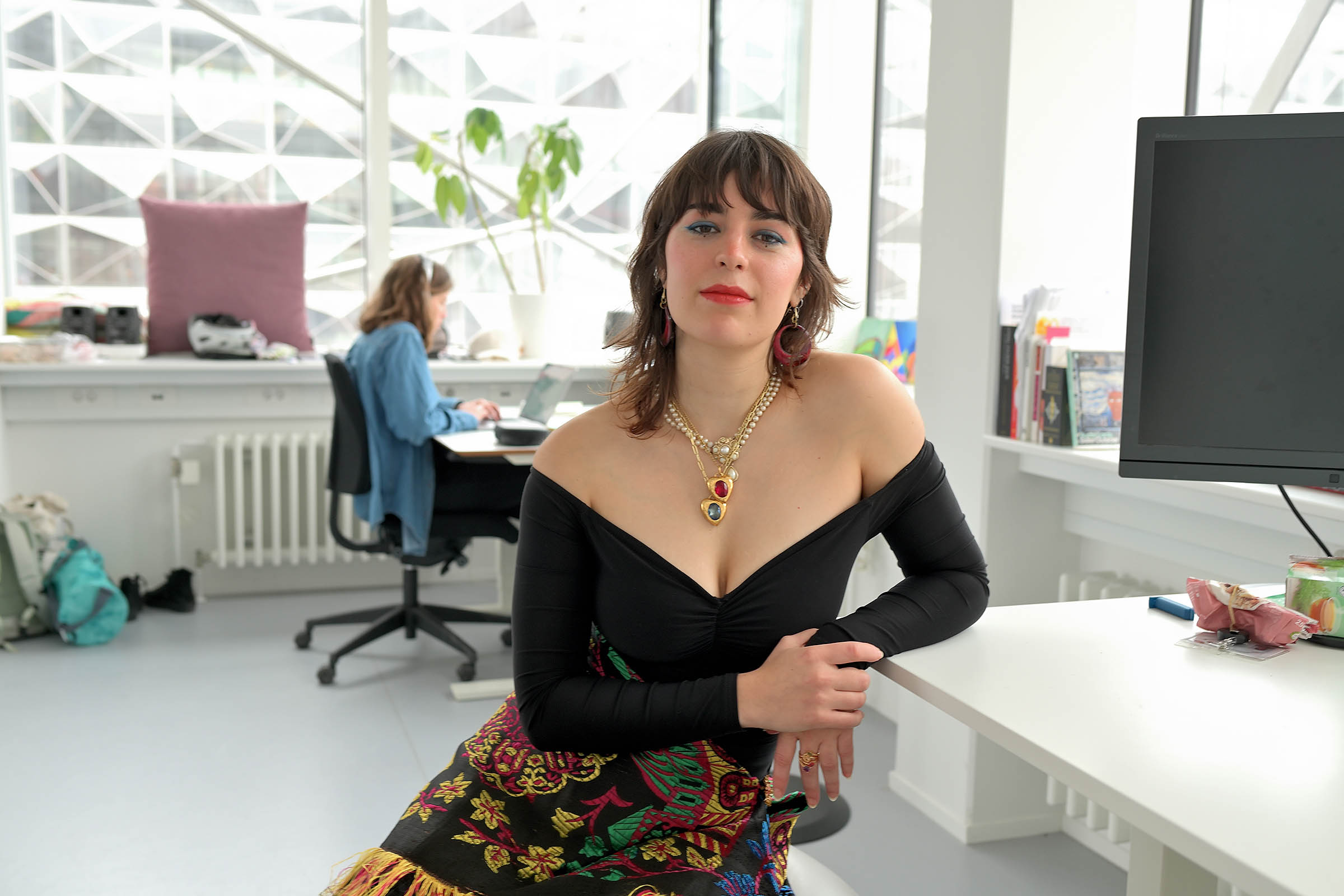
PhD researcher Clara Ferreira Cores is in a corner office at the Niels Bohr Institute (NBI) at the University of Copenhagen (UCPH).
Many have done their PhDs in this office before her. But their dissertations usually deal with quantum technology or particle physics: She, however, sees herself as both a physicist and an artist.
Clara Ferreira Cores’ project explores how the natural sciences can benefit from art in terms of working methods and approaches.
Her thesis is that the two worlds can exchange ideas and methods.
»I have always been fascinated by how we generate knowledge across cultures and history. To me, the exchange of ideas and methods makes sense. Scientific practice has its own methodology that strives for objectivity. Artistic methodology does not always seek the same thing, but it can still shake up science’s habitual ways of thinking,« says Clara Ferreira Cores.
Clara Ferreira Cores was first employed at the Dark Cosmology Center in April 2025 to do research into statistical mechanics and gravitational systems that challenge our classical understanding of thermodynamics — because some physical systems behave in ways that differ from expectations.
READ ALSO: Astrophysicists solved mystery of red dots
In her PhD, Clara Ferreira Cores builds on the idea that just as art cannot be understood solely as aesthetics, so science cannot only be understood as epistemology. Habitual thinking can be challenged in both directions.
New thinking across disciplines
The title of Clara Ferreira Cores’ PhD is Transdisciplinary Research — Time Through the Lens of Art & Science.
She has helped set up a website Yonderartscience.com with her supervisors, physicist Jens Hjorth and art historian Irene Campolmi, and the astrophysicists Jo Verwohlt and postdoc Judit Pratt. It outlines a future where artistic and scientific methodologies intersect.
Her PhD is scheduled for completion in April 2028.
In her own research, she needs to learn to think in new and different ways if she is to solve the challenges of understanding the laws of thermodynamics both at the nanoscale and in cosmic structures, she explains.
In her own field, it is specifically ‘time’ as a phenomenon that presents challenges. So she lets her thinking be challenged by the ways in which time can be broken up — both across different reference systems and across different cultures.
A transdisciplinary concept that she is developing opens up the possibility of being attentive with all your senses. This lets researchers go beyond entrenched academic boundaries and produce truly innovative work, she says.
Clara Ferreira Cores came to Copenhagen after first completing her bachelor’s degree in astrophysics in Scotland in 2020. She completed her master’s degree in quantum physics at NBI, graduating in 2022.
While living in Copenhagen, she has been trained in circus arts at a Danish folk high school for the performing arts— specialising in flying trapeze and group acrobatics. Ever since her childhood, she has been as much into art and culture, as she has been into physics.
Physics now takes up most of her time, but her interest for art and culture remains unabated:
»Even as a teenager, I had an almost insatiable hunger for knowledge that made me ask lots of questions in physics classes, even though it drove my teachers to distraction. But my love for art was just as strong, and I would almost be pained by the fact that they are separated,« she says.
As a child, she began dancing, later joining a Galician folkloric ballet group, performing in both Spain and abroad.
At the age of 16, she moved to the United States to graduate from an arts high school. Since then, she has practised almost every art form, including literature and philosophy — but physics ultimately became her chosen field of study.
When the Niels Bohr Institute set up a PhD fellowship in 2024 that brought together artistic, scientific, and philosophical research, it was a perfect fit for her, and she began working on the PhD in the summer of 2025.
She remains an active artist. This includes performing a piece at the Centre of Gravity at the institute.
Both she and her supervisors see the PhD project as pioneering work, and it is too early to say what it will ultimately lead to. But the idea is that she will describe how we generate new knowledge in fields beyond physics.
»No matter how eccentric my PhD project may seem, there are loads of researchers across the globe searching for new ways of thinking and studying, because they feel trapped in silo thinking in the name of efficiency and productivity,« says Clara Ferreira Cores.
This article was first written in Danish and published on 23 March 2026. It has been translated into English and post-edited by Mike Young.