




Universitetsavisen
Nørregade 10
1165 København K
Tlf: 35 32 28 98 (mon-thurs)
E-mail: uni-avis@adm.ku.dk

—
Science
Open research culture — Research team at the Niels Bohr Institute cracked the enigma of red light sources in the early universe. We talked to the astrophysicists who were first to unravel the mystery.
A new phenomenon set the world’s astrophysicists and other researchers abuzz in June 2022.
The James Webb telescope, the largest and most complex telescope ever sent into space, began transmitting images to researchers on Earth.
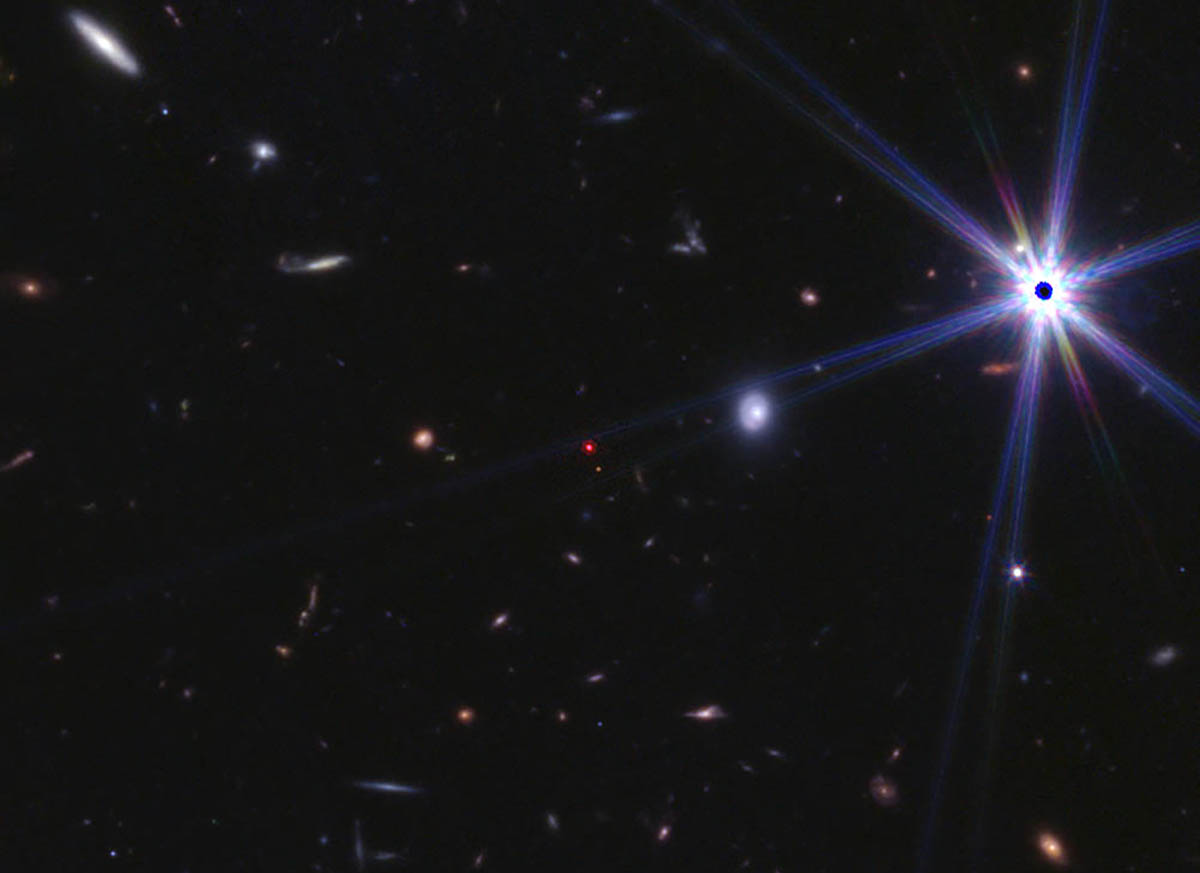
In them, there were some small reddish spots that no one could explain, but which scientists immediately named Little Red Dots, or LRDs.
Were they young galaxies — or a previously unknown phenomenon in the early universe? The universe is now 13.8 billion years old, but by looking deep into space, the James Webb telescope also looks back in time — revealing objects as they appeared just 1.5 billion years after the Big Bang.
Around 1,400 physicists from throughout the globe began studying the phenomenon. This included a dozen from the Cosmic Dawn Center at the Niels Bohr Institute (NBI) at the University of Copenhagen (UCPH), and seven more researchers from the University of Cambridge in the UK.
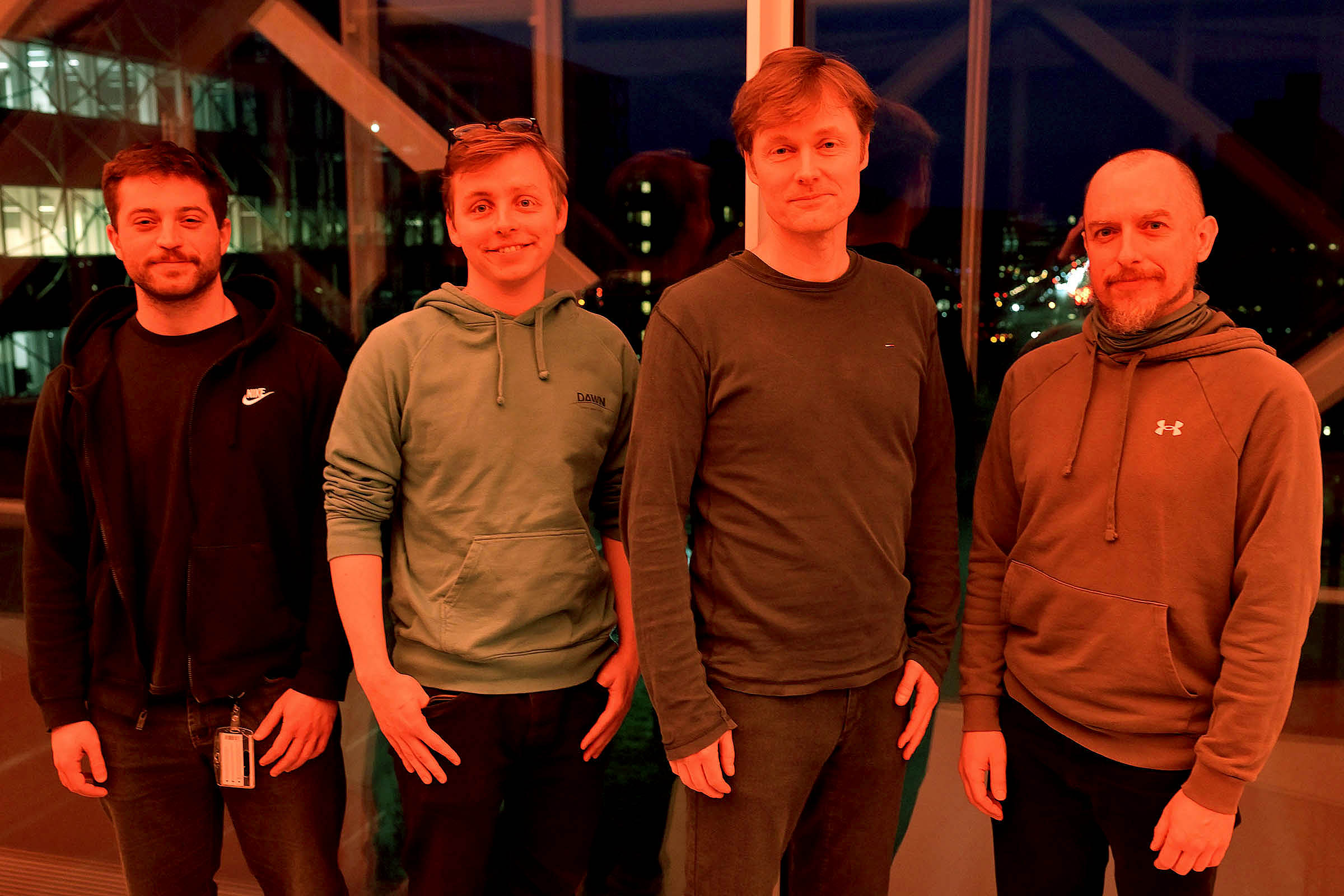
Professor Darach Watson heads the LRD team at UCPH, which ended up solving the red dot enigma.
Their work made the cover story of the journal Nature in January 2026.
The researchers spent a long time considering whether LRDs had anything to do with black holes, before they were finally able to prove that they, in fact, did.
An NBI colleague of Darach Watson, Associate Professor Gabriel Brammer, set up an archive in 2023 that contained all the available data from the James Webb telescope.
The public archive has since become one of the centre’s most important assets, and the images from the James Webb telescope showed light phenomena that all resembled the small red dots.
Researchers at the Cosmic Dawn Center worked with the theory that the phenomena might be black holes right from the start. But the observations did not support it, as the LRDs gave off a constant light and did not emit the bluish hue that is normally observed in black holes. No X-ray radiation was emitted from them either — something that is normal for black holes.
The small red dots could not be stars or quasars, and they were too small to be galaxies.
The researchers were completely at a loss.
READ ALSO: Astrophysicist honoured for uncovering black holes’ orbital secrets
News of Gabriel Brammer’s archive was shared with researchers throughout the world: In physics it is no advantage to keep your data to yourself.
»Both Gabriel Brammer, others, and I myself believe that the data should be freely available. There are arguments that we should keep it private so our PhD students have more time to work with them: But we believe that keeping data open is better, in spite of all the arguments against it,« says Darach Watson.
A new scientist joined the project after it had already begun. This was PhD fellow Albert Sneppen, who also started working with the LRDs in the spring of 2025.
There is simply something about the research setting that has everyone continuing to share their data, even though we work in a competitive environment that of course makes us ambitious
Albert Sneppen
Albert Sneppen works with advanced computer models and has developed the theoretical model that researchers now use to show what the red dots are revealing to them.
Albert Sneppen appreciates that the research community in his field is open and democratic.
»There is simply something about the research setting that has everyone continuing to share their data, even though we work in a competitive environment that of course makes us ambitious. Everyone wants to be the first to come up with an answer,« says Albert Sneppen.
Scientific staff at the Cosmic Dawn Center did, in fact, also made a determined effort to be the first to solve the LRD mystery. This is why Russian postdoc Vadim Rusakov, who works on analysing the physics of gas and dust clouds, was attached to the project. It would have taken Darach Watson much longer to carry out that type of analysis himself, he explains.
PhD fellow Georgios Nikopoulos also joined up, with his role being to find evidence supporting the researchers’ hypotheses about the LRDs.
»I used a catalogue of the red dots that I compiled based on the knowledge we gained from the James Webb telescope. I investigated whether they behaved according to the theoretical model that Albert Sneppen developed,« says Georgios Nikopoulos.
READ ALSO: Black holes — and the physics and dreams of Albert
The combined efforts of the Cosmic Dawn Center ultimately led to a breakthrough in understanding the red dots. But it happened almost by accident.
Darach Watson had studied Gabriel Brammer’s archive for some time when, in May 2024, he came across a scientific article about X-ray radiation and dust that gave him an aha moment:
»The article suggested that the LRDs might be black holes surrounded by hot gas, so that X-ray radiation could not escape through it. At first I thought that couldn’t be right, because then no light could escape from the gas cloud either,« says Darach Watson.
The electrons in the gas cloud would block all light if it were dense enough to block X-rays.
It’s fine to discuss — and that is part of what makes physics fun
Darach Watson
But then Darach Watson suddenly realised that there could be two different types of opacity: One is absorption, where light is absorbed so that it disappears completely. The other is scattering, where light waves interact in many different directions with matter multiple times.
»Scattering could allow the light to escape, and you would be able to see this by studying the profile of colours or wavelengths in the light’s spectrum. I calculated what that spectrum should look like, and then I looked for it in our data — and found it,« says Darach Watson.
It remains a mystery to researchers how the LRDs were formed and what will eventually become of them. Researchers are still working on the phenomenon and, according to Darach Watson, more than one scientific article about them is now published every day.
The scientific community may not end up coming to an agreement on how the supermassive holes formed so early in the universe. But that doesn’t matter, because in black holes research there is space for disagreement:
»Debate is a good thing — and that is part of what makes physics fun,« says Darach Watson.
READ ALSO: The Bohr legacy
This article was first written in Danish and published on 10 March 2026. It has been translated into English and post-edited by Mike Young.