



Universitetsavisen
Nørregade 10
1165 København K
Tlf: 35 32 28 98 (mon-thurs)
E-mail: uni-avis@adm.ku.dk
—
Politics
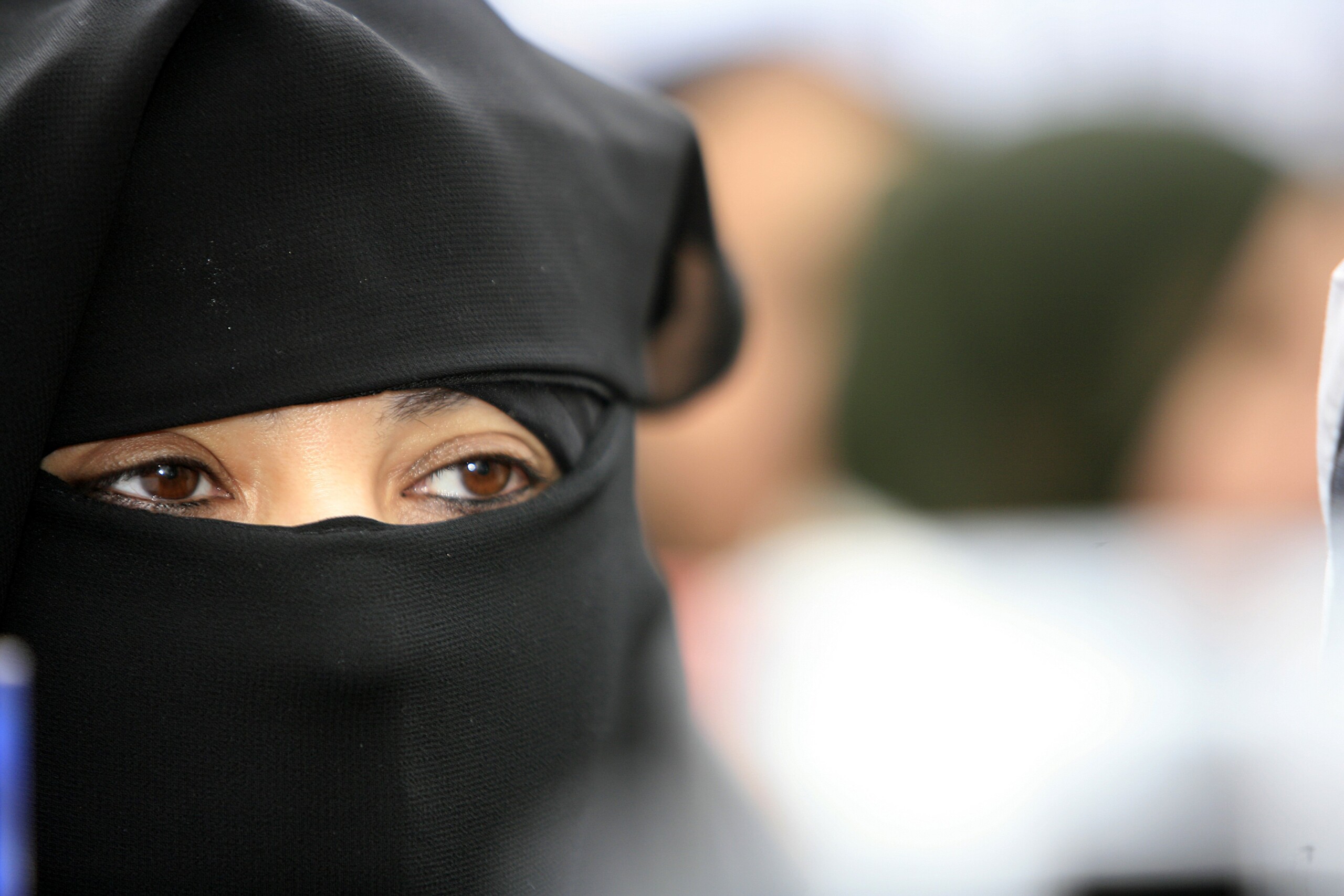
Face veils — Plans to ban the face veil at the country’s educational institutions follow recommendations from a former government's women’s rights commission. Scholar of Islam says he has never actually seen a niqab there.
The Danish government wants to extend a ban on face veils in public spaces to also apply to educational institutions.
This was announced by Minister for Immigration and Integration Rasmus Stoklund (Social Democrats) before the end-of-year break.
»Burkas, niqabs or other garments that cover people’s faces have no place in Danish classrooms. A ban on face-covering already applies to public spaces, and it should naturally also apply to places of education,« the minister stated in a press release.
The current ban primarily targets Islamic head coverings and came into effect in August 2018. It prohibits garments that cover the face, unless there is a »worthy purpose« for doing so.
»We think it’s only natural that the same rules apply when you’re at school or in a place of education,« the Minister for Higher Education and Science Christina Egelund said in the government’s press release.
The government expects to present a bill with the extended ban in February 2026.
The proposal comes in the wake of a so-called ‘commission for the overlooked women’s rights struggle’ that was set up by the former, Social Democrat, government in 2022.
The commission had the purpose of ensuring that minority women have the same rights as other women in Denmark, and its work resulted in 13 recommendations, which were presented in January 2025.
I am prepared to stand by the principle that face-covering — in principle — erases the individual
Thomas Hoffmann, Islam scholar and professor of theology at the University of Copenhagen
»It should be ensured that institutions do not have systems that enable honour-based violence and social control, and for this reason the existing face-covering ban, which applies in public spaces, should also apply to educational institutions,« read one of the commission’s recommendations.
But how many people actually wear niqabs at Danish educational institutions?
The University Post asked a scholar of Islam and professor of theology at the University of Copenhagen, Thomas Hoffmann:
»I haven’t done fieldwork or conducted a major survey, but if you walk around campus, you won’t see anyone wearing a niqab. As far as I know, the phenomenon doesn’t exist at the University of Copenhagen or at any other Danish university,« he said.
But if no one is veiled at the universities, then what’s the point of extending the ban?
»[The Minister for Immigration and Integration, ed.] Stoklund speaks of due diligence. If you look at trends in European countries like France, Belgium and the UK, there has been a rise in the number of women wearing niqabs, which has then led to various forms of state and legal interventions. So the due diligence argument has merit. But I also think they want to do it because they want to make a principled statement about face-covering,« said Thomas Hoffmann, and continued:
»And from a practical and pedagogical perspective, it is challenging — whether it’s a niqab or a balaclava — if someone has facewear on during face-to-face communication. It’s like being on a Zoom call where one person has a black screen and the other person is visible. There’s a kind of asymmetry in that.«
The commission’s recommendation implies that face-covering is a form of social control. What does the research say?
»The research is very divided — also on this point. A classical feminist view would say that face-covering specifically of women — and only women — erases the woman as an individual in civil society, and that it is therefore a gender-discriminatory, pre-modern and patriarchal practice. But feminism today is many different things. Others would argue that covering up is about free choice.«
What’s your own academic assessment?
»I am prepared to stand by the principle that face-covering — in principle — erases the individual. But it’s a classic dilemma of freedom that I think should be up for debate. It’s a philosophically, pedagogically and politically fascinating issue, and that’s why we should talk about it — hopefully in a way where opposing views are heard and the issue is discussed in a deliberative manner,« says Thomas Hoffmann.
The government’s plans come shortly after the University of Copenhagen chose to close its retreat rooms, which were primarily used as prayer rooms by Muslim students.
The University Post has asked UCPH management to comment on the government’s plans, but they do not wish to comment on the issue.
This article was first written in Danish and published on 19 December 2025. It has been translated into English and post-edited by Mike Young.