
Universitetsavisen
Nørregade 10
1165 København K
Tlf: 35 32 28 98 (mon-thurs)
E-mail: uni-avis@adm.ku.dk

—
Science
Freedom of research — After a summit called by the Minister for Higher Education and Science on academic freedom, a warning from humanities dean Kirsten Busch Nielsen: In a polarised public debate researchers are avoiding some topics.
How do you safeguard academic freedom when you are under intense political scrutiny, when there is close collaboration between universities and the outside world, and when there is an increasingly polarised public debate?
This was the question from university managers, researchers, politicians and representatives from organisations when the Danish Minister for Higher Education and Science Christina Egelund invited them in for a summit on academic freedom in the ceremonial hall of the University of Copenhagen (UCPH).
The meeting drew on an update to a Danish code of conduct for research integrity which the ministry presented at the end of January. Here, freedom in research is highlighted for the first time as a standalone principle.
I hear of researchers who have to hold their ground with unreasonable tenacity just to keep saying what they know to be right
Kirsten Busch Nielsen, Dean of the Faculty of Humanities
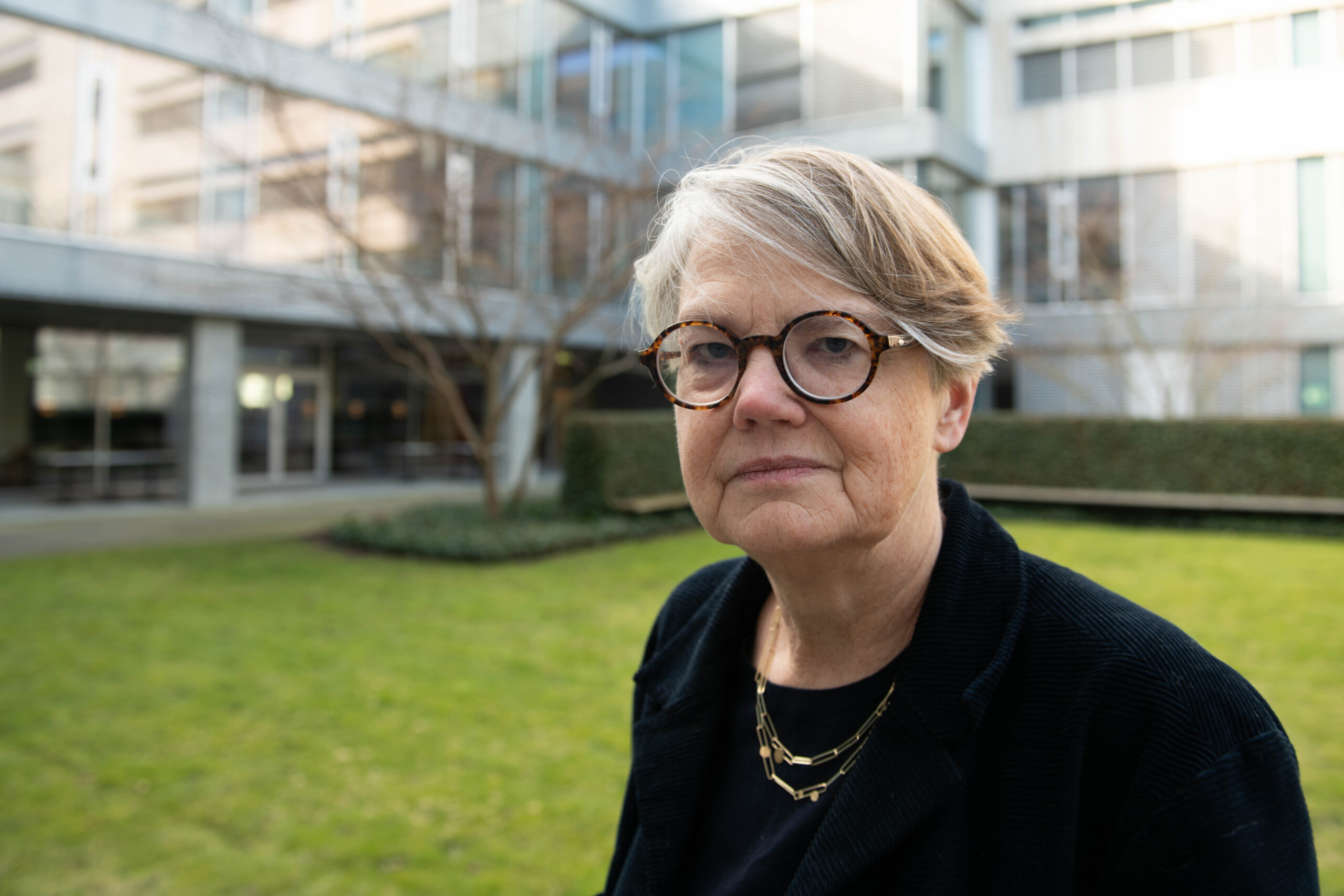
Kirsten Busch Nielsen, Dean of the Faculty of Humanities and sponsor and spokesperson for the work on academic freedom at UCPH, was at the summit. For her it is not a new discussion: Academic freedom is both a precondition for the role that universities play in society — and a value that requires ongoing attention.
»It is part of the social contract between the university and society, that this society asks the university to generate knowledge through free enquiry,« she says.
The pressure on researchers is not necessarily always direct or visible.
»Researchers may respond by withdrawing from certain topics — in their research, in their teaching, or in their public communication. And that is plainly bad for society,« she says.
Researchers feel their academic freedom is being constrained and, according to Kirsten Busch Nielsen, this is due to several factors.
She points to changes to funding models, the closer collaboration with public authorities and private companies, and a more polarised public debate.
Researchers working on politically contentious subjects — such as climate, gender, religion and vaccines — find that their work is read as political commentary, even when they clearly keep their distance from political debate.
»I hear of researchers whose ability to communicate their work has become difficult, and who have to hold their ground with unreasonable tenacity just to keep saying what they know to be right: to keep saying what is important that they do say,« explains Kirsten Busch Nielsen.
Social media, the dean adds, can also amplify conflict around certain fields of research.
Researchers often have to consider carefully when it makes sense to step into the public arena, Kirsten Busch Nielsen notes. In some cases, it can be necessary for them to just »keep their heads down«, because the debate is so polarised that research findings are quickly reduced to just another viewpoint in a political dispute.
Is it not admitting defeat to say it can be necessary to keep your head down rather than insisting on academic freedom?
»Yes, but you cannot say this as a general rule. The university has an obligation to conduct research, provide education and drive innovation — and to share knowledge. But that does not mean that every researcher needs to be publicly communicating all the time to the same degree,« says Kirsten Busch Nielsen.
Academic freedom was named as a strategic precondition in the UCPH strategy in 2023.
But this does not mean that academic freedom is something that has only come to matter now, according to Kirsten Busch Nielsen.
»It has been important all along. Now it is just made explicit,« she says.
The point, according to the dean, is that the university cannot fulfil its other strategic ambitions without having clarity about the values that underpin them.
Alongside the precondition of shared responsibility for academic freedom is also the fact that the university must be a place where views are challenged, and where we can disagree.
The summit confirmed her view that UCPH is on the right track in its work to safeguard academic freedom.
»We have made a good start with our own work. In a sense, you can never do enough when it comes to the question of values. But the fact that we now have written academic freedom explicitly into our strategy as one of its preconditions shows how important the issue is,« says Kirsten Busch Nielsen.
To bring these ambitions to life, UCPH has set up three working groups. The groups are tasked with addressing academic freedom in research and innovation, in early-career researchers, and in teaching and learning, respectively.
The groups consist of researchers, students and university managers, and they began their work shortly before Christmas.
The aim is to formulate principles for academic freedom, and to develop specific tools for handling dilemmas in practice.
One of the areas the working groups will examine more closely is the situation facing early-career researchers.
The debate here has centred on whether temporary positions and dependence on external funding can affect whether researchers have academic freedom in practice.
»We know that early-career researchers can experience it as pressure on their research that they need to make sure they align themselves with senior researchers who can secure funding for their work. And I recognise that experience only too well,« says Kirsten Busch Nielsen.
READ ALSO: 130 researcher testimonies expose a culture of fear and silence at Danish universities
How early-career research at UCPH will be structured going forward is something that Kirsten Busch Nielsen is not willing to comment on now, as she wants the working group to progress further with the topic first.
The new initiatives show that academic freedom has risen higher on the agenda among both politicians and university managers.
Yet in opinion pieces and featured comments, critics say that things often amount to little more than rhetoric, and that results rarely emerge from the work.
Kirsten Busch Nielsen believes this criticism is based on a misconception.
»I understand the criticism. But there is also a misunderstanding embedded in it — as though someone owns academic freedom and needs to hand it out to others. Yes, academic freedom is entrusted to universities by the legislature, and research freedom is highlighted in the Danish University Act. And yes, we can look at structural matters. But beyond that, I see academic freedom as a shared responsibility, something that is framed by managers, staff and students — each in different ways, of course. That is why I think we should now let our working groups do their work. I doubt that they are simply writing nice speeches. They are working closely with the material, the problems and the dilemmas. And if these groups identify things where we need clearer guidelines, then we must work out whether and how that can be addressed,« says the dean, and continues:
»Alongside the precondition of shared responsibility for academic freedom is also the fact that the university must be a place where views are challenged, and where we can disagree.«
Kirsten Busch Nielsen dismisses the idea that UCPH has a general problem with academic freedom.
»I don’t think so. But we will have a problem if we do not dare to address the testimonies and examples of pressure that we know are out there,« she says.
This article was first written in Danish and published on 9 March 2026. It has been translated into English and post-edited by Mike Young.