


Universitetsavisen
Nørregade 10
1165 København K
Tlf: 35 32 28 98 (mon-thurs)
E-mail: uni-avis@adm.ku.dk
—
Education
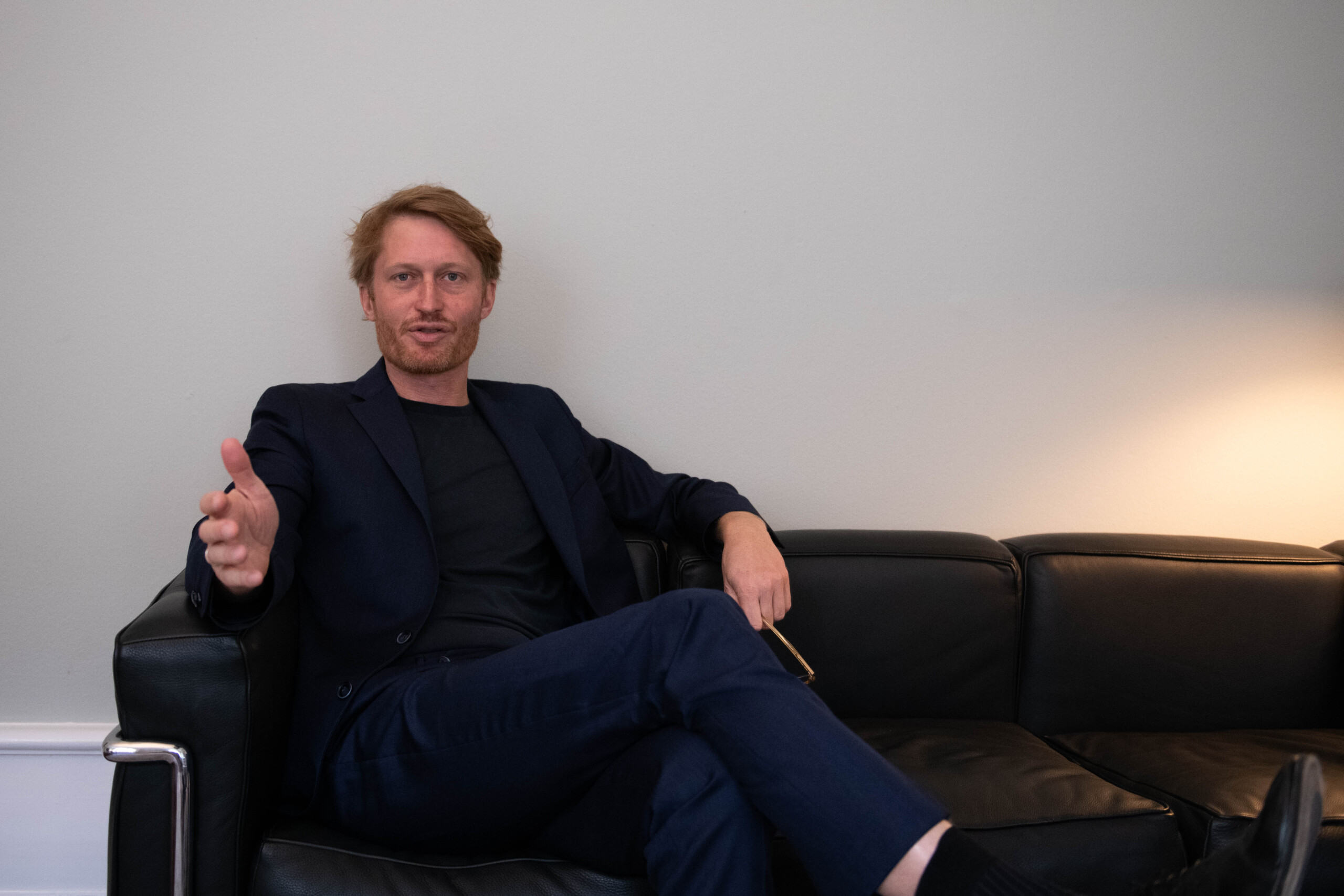
Academic friction — The best moments of Kristian Lauta’s student years came when lecturers ventured beyond the curriculum. He wants to pass that experience on as UCPH’s Prorector for Education, a role he will now hold until 2030. At the same time, he must navigate artificial intelligence, student protests and a master’s degree reform he remains critical of.
Kristian Lauta has a failed book project sitting in his desk drawer.
That is his own description of the piles of notes he has been working on for three years, exploring friction and how we grow when we encounter resistance.
Profile
Born in 1982 in Holbæk.
Earned a master’s degree in law in 2008 and a PhD in 2012, both from the University of Copenhagen.
Prorector for Education at UCPH since 15 June 2022. His appointment has been extended until 2030.
Associate Dean for Education at the Faculty of Law from 2019 to 2022.
Professor of Law whose research focuses on disasters, climate and risks, including how they are regulated and how they shape the law.
Author of several books, including Katastrofer – og hvad de kan lære os om os selv (Disasters – and what they can teach us about ourselves), published in 2021.
Married and a father of four.
Although the project has stayed in the drawer, the effort has not been wasted, the prorector says. What it has not earned him in library royalties, it has given him in new perspectives. Not least on the question of artificial intelligence at the University of Copenhagen, perhaps the most important issue for both university leaders and people across campus over the past year.
»AI challenges the way we have traditionally thought about learning. And when technology can help students write and find answers, we as a university have to consider what students need to be able to do themselves, and how they actually learn,« says Kristian Lauta.
For him, AI forcing the university to reconsider its habits and think in new ways is a concrete example of the book project’s question of growing through resistance.
»In that sense, AI is obviously a disruption. But approached in the right way, it is an opportunity to actually strengthen UCPH and improve our degree programmes,« he says.
He now has more time to work on that task. In September, Kristian Lauta’s appointment as Prorector for Education at the University of Copenhagen was extended by three years, taking his term to 2030.
Education was already a prominent part of Kristian Lauta’s childhood home in Holbæk. His father was a headteacher and his mother a teacher, so conversations around the dinner table often turned to learning and intellectual development.
This also gave him an early sense of what good teaching meant to him. When he was studying law at the University of Copenhagen, it was particularly the lecturers who ventured a little beyond the curriculum who made an impression.
»For me, there was a particular beauty in being allowed to explore a line of inquiry that offered a freer space for learning,« says Kristian Lauta.
As a lecturer, he has tried to pass that experience on. Although teaching, as he puts it, »must of course be connected to the exam«, there should also be room for tangents and new perspectives that can inspire students.
»Ideally, it should create those little moments of magic when you think: God, this is just fascinating, and here is someone who knows a great deal about something,« he says.
»But students at the University of Copenhagen may not get to experience that as much as I would like. I am willing to acknowledge that.«
The question of freedom and boundaries also follows Kristian Lauta beyond the classroom. As prorector, he has to make room for students to challenge their university, while helping to set its boundaries.
He says that some of the most difficult considerations during his time as prorector have concerned the protests by Students Against the Occupation, a group campaigning for, among other things, an academic boycott of Israel. Here, in his own words, he has had to find a balance between the university’s different obligations.
»UCPH has to be an institution that ensures order and predictability. But at the same time, students must be able to take ownership and challenge it,« says Kristian Lauta.
Do you think you have succeeded in finding that balance in this case?
»I actually think we have. I think we have got it about right. But I am not sure it is a balance you can find and then be done with.«
In his view, similar debates and issues will create the same tension in the years ahead.
It is an idiotic policy for Denmark to insist on providing less education
And although some students are better than others at making their voices heard, he does not see that as a problem in itself.
»I think students should be allowed to make their presence felt at the University of Copenhagen,« he says.
READ ALSO: Prorector: Students crossed the line in blockade attempt
But students who do not necessarily take to the barricades must also be heard. Kristian Lauta therefore wants more students to get involved in the university’s many councils and boards of studies and help improve decision-making at UCPH.
»Sometimes they ask fundamental questions about whether we have thought things through properly from the outset. At other times, they identify small but important aspects of something we have overlooked that make a huge difference to students,« he says.
He himself sits at the head of the table, where he has to bring together the different interests of students, lecturers, local leaders, interest groups and the public.
»The times when being prorector is hardest for me are when I am put under pressure to take sides.«
One of the tasks that has taken up much of the prorector’s time, and will continue to do so during his second term, is the master’s degree reform.
READ ALSO: UCPH braces for master’s degree reform: »We can’t afford to get it wrong«
The agreement, reached by a political majority in 2023, significantly changes the universities’ existing range of master’s programmes. The aim is for 20 per cent of new master’s students in 2032 to enrol in a so-called master’s programme for working professionals, combining study with paid employment, while 10 per cent enrol in a shorter master’s programme. The agreement has also led to reductions in undergraduate admissions at Denmark’s universities.
If you can use artificial intelligence to become better at learning and to understand something you would otherwise not be able to understand, then for God’s sake, do it
Management is putting the finishing touches to the university’s own proposal for what the range of master’s programmes at UCPH should look like. This will then need approval from the Ministry of Higher Education and Science.
»It is a huge change in what it means to be a student and what it means to be a university. And I think it is the biggest educational construction project during my time in leadership,« says Kristian Lauta.
Words such as ’attractive’ and ’exciting’ recur when he talks about the new programmes. But that does not change the fact that the entire university sector fiercely opposed the reform before the agreement was reached.
And when pressed, the prorector acknowledges that, despite his positive language, he still sees the reform as a deterioration in the overall educational offering.
»It is an idiotic policy for Denmark to insist on providing less education,« says Kristian Lauta.
»There is nothing I said during the political debate that I do not stand by.«
Even so, he sees academic opportunities in the programmes being developed. The aim is to make the new, shorter master’s programmes worth 75 ECTS credits and the master’s programmes for working professionals so good that some students prefer them to traditional master’s programmes.
»So I am convinced that UCPH will continue to produce capable graduates in the future,« he says.
The current plan ensures that UCPH’s own bachelor’s graduates retain their right to a place on a traditional master’s programme. Choosing one of the new master’s programmes will therefore be an active choice, Kristian Lauta explains.
If too few of UCPH’s own bachelor’s graduates choose them for the university to meet the politically determined quotas, students from other universities who want to take a master’s degree at UCPH will be affected instead. In that case, they will only be able to choose one of the new programmes. If they turn down that offer, it will cost UCPH both students and revenue, the prorector acknowledges.
»We are taking the risk. We believe we can create programmes so good that students choose them of their own accord,« says Kristian Lauta.
If none of UCPH’s own students choose the new programmes, the university will have to change course, he adds.
Overarching the work on the master’s reform and the other changes is a new reality that is reshaping not just the university, but society as a whole: artificial intelligence. The technology affects many parts of UCPH at once, and according to Kristian Lauta, the pace places different demands on the university from those it is used to.
For the prorector, the task is to work out how AI can be used in individual subjects to help students actually learn something.
»I am not particularly preoccupied with the issue of cheating,« says Kristian Lauta, adding:
»We are here to learn, not to hold exams. If you can use artificial intelligence to become better at learning and to understand something you would otherwise not be able to understand, then for God’s sake, do it.«
This also applies when students use AI to write and produce text, he explains. They must be able to explain how they have used it and critically assess the result.
If anyone is dreaming that we in management can issue a set of rules that will resolve all the complexities of artificial intelligence, I would like to burst that bubble
Lecturers and students must help work out together how this should happen in individual subjects. Students must be able to ask questions and demand answers from their lecturer when they are unsure what to do.
»It requires a shared understanding of expectations. It requires ongoing agreements, and that, damn it, is what learning is,« he says.
But doesn’t UCPH risk ending up with 117 different agreements from one course to the next?
»Of course there has to be a common framework for how we work with artificial intelligence,« says Kristian Lauta.
This will be one of the tasks for UCPH’s new Deputy Prorector for AI, Morten Axel Pedersen, he explains. The framework must cover teaching, exams and what students need to learn about the technology.
READ ALSO: Here is UCPH’s new deputy prorector for AI
There will still, however, be questions that the rules do not answer, which lecturers and students will have to resolve together, he believes.
»If anyone is dreaming that we in management can issue a set of rules that will resolve all the complexities of artificial intelligence, I would like to burst that bubble.«
As a student, Kristian Lauta spent three years on the faculty council at the Faculty of Law. Among his memories of student politics is his first meeting of the Rector’s Education Committee, where »UCPH’s internal market for education« was on the agenda.
The idea was to make it easier for students to take courses across the university and access teaching outside their own degree programme.
Around 20 years later, as Associate Dean for Education at the Faculty of Law, he attended a similar meeting. The same item was on the agenda.
»In the intervening 20 years, nothing had happened,« he says.
This is one of the concrete areas where he hopes students will be able to feel a difference by the time his appointment ends in 2030.
»I think we have a unique opportunity now to create a framework for the University of Copenhagen in which students will find it much easier to move across disciplines. They will be able to access many more courses from across UCPH’s full academic range and gain a much richer education as a result,« he says.
At the same time, he hopes the university can make more room in future for the moments he remembers from his own student days: becoming absorbed in something because it is exciting, even when it falls outside the curriculum.
»If there is one role a university has, it is surely to keep allowing itself to be seduced by knowledge and to pass on that fascination and curiosity to the next generation of academics,« he says.