


Universitetsavisen
Nørregade 10
1165 København K
Tlf: 35 32 28 98 (mon-thurs)
E-mail: uni-avis@adm.ku.dk
—
Campus
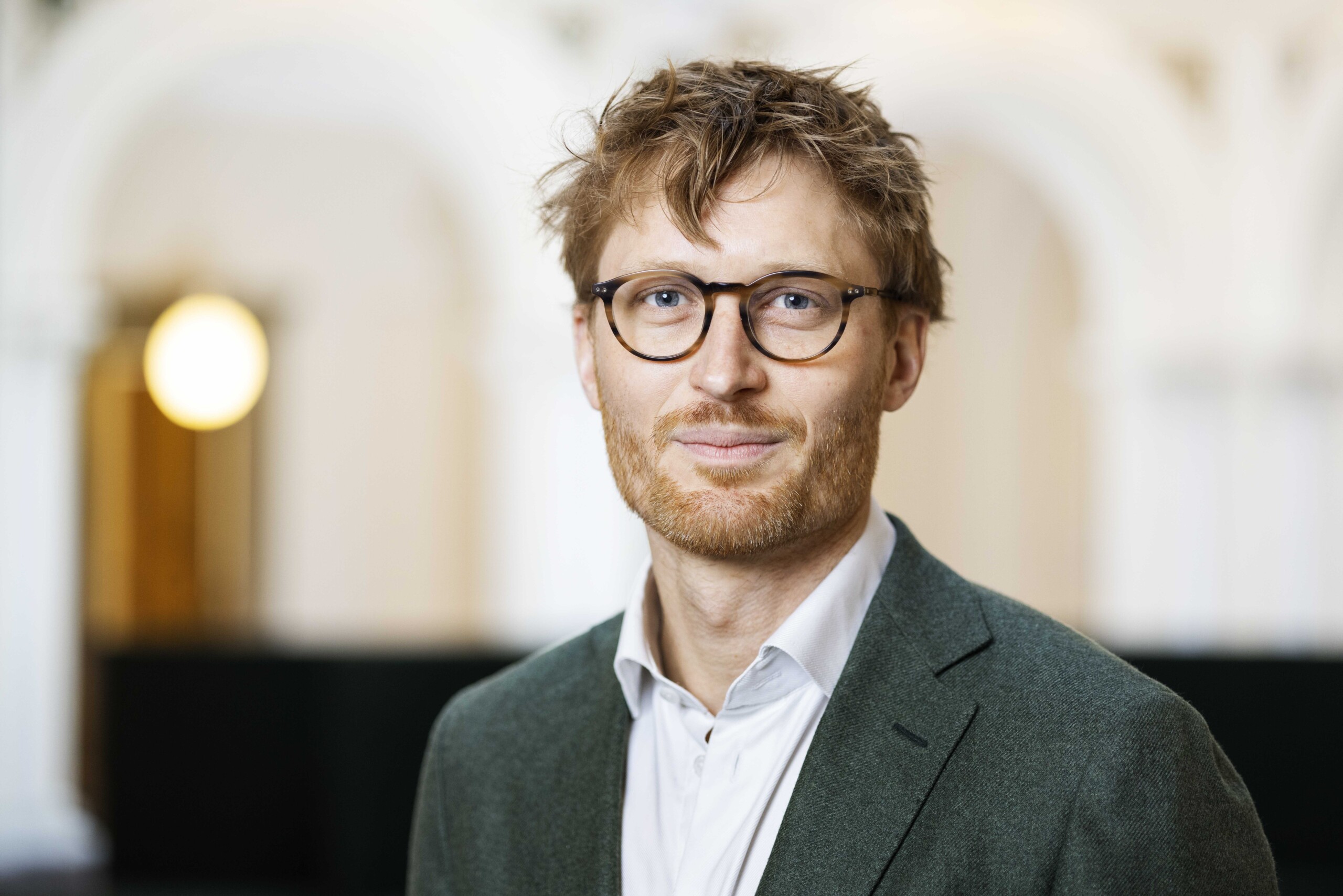
Trespassing — Five University of Copenhagen students are set to stand trial following an attempt to block and occupy the Museum Building in September 2024. Prorector Kristian Cedervall Lauta describes the events as tragic, but maintains that the university cannot interfere in the court case.
It is »tragic« that the case concerning the occupation of the Museum Building is now ending up in court.
That is according to Kristian Cedervall Lauta, Prorector for Education at the University of Copenhagen, regarding the case against the five University of Copenhagen students charged with trespassing after their attempt to occupy the rectorate’s headquarters, the Museum Building, on the 4th of September, 2024.
»My heart bleeds for both the University of Copenhagen and for the students. But it is up to the Public Prosecutor’s Office to determine whether a criminal offence has been committed,« he tells The University Post.
The case began on a dramatic morning when the student movement Students Against the Occupation attempted to block and occupy the Museum Building at Frue Plads in order to pressure the university into introducing an academic boycott of Israeli universities.
READ ALSO: Student protesters blockade central University of Copenhagen buildings
According to an internal survey among employees seen by The University Post, 10–15 masked individuals entered the building early that morning and asked employees to leave their workplaces.
My heart bleeds for both the University of Copenhagen and for the students. But it is up to the Public Prosecutor’s Office to determine whether a criminal offence has been committed
Kristian Cedervall Lauta, Prorector
The police were called, and the action ended with six people being arrested. Five of them were University of Copenhagen students, who are now set to appear in court. The sixth person arrested was the world-famous climate and human rights activist Greta Thunberg.
The students charged in the case tell The University Post that they want the university to actively intervene and tell the police and the prosecution that this was a student blockade, not trespassing. But Kristian Cedervall Lauta rejects that idea.
READ ALSO: Student activists to stand trial after blockade attempt
»We have had nothing to do with the case since we called the police that day. The basis for police involvement was that masked individuals had entered the Museum Building, and from that point onward the authorities handled the matter themselves,« he says, adding:
»We withdrew a compensation claim that the police wanted included. But beyond that, it must be up to the Public Prosecutor’s Office to determine whether the students committed a criminal offence. Technically speaking, a trespass has been committed, and as far as I know, we have no ability to influence the prosecution’s assessment of the case.«
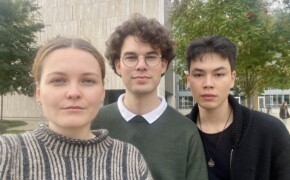
Uniavisen has spoken with four of the five students who are set to appear in court on the 24th og 25th of June.
In addition to the ongoing court case, the students have been through internal disciplinary proceedings, all of which resulted in written warnings for violating §1 of the University of Copenhagen’s code of conduct, concerning conduct that causes inconvenience to others.
The students argue that their action in September 2024 should be regarded as a student blockade in line with previous blockades at the University of Copenhagen — including the HUM blockade in 2019 and the Psychology blockade in 2022. On those occasions, entrances were also blocked and employees denied access, yet the police were not involved and no students faced internal sanctions.
According to the students, it is problematic that a student protest has now ended up in court.
I think the premise is unreasonable. What kind of pressure is that to place on people who go to work every day under completely ordinary employment conditions?
Kristian Cedervall Lauta, Prorector
»We haven’t been able to find any examples in history resembling this. We are deeply concerned about the shift we are witnessing. And we fear that the kind of student activism that has helped define the University of Copenhagen may no longer be possible,« says Emil Nielsen, one of the students charged in the case.
Asked whether the students wish they had done anything differently, the response is:
»In retrospect, you could say that we never should have done it. But that’s difficult, because we saw it as a completely legitimate action — and we still do. And we think it’s very extreme that we are being punished for this both internally and externally,« says Özgür Yegâh, who is also among the students charged in the case.
The students fear that the case could set a new precedent for how the university handles student activism and blockades. But according to Kristian Cedervall Lauta, the events of September 4 were unprecedented and cannot be compared to previous student actions at the University of Copenhagen:
»Masked individuals forced their way into a building located 50 meters from the Copenhagen Synagogue at a time when the protest movement was at its peak in Denmark. They did not identify themselves. They had not announced themselves in advance. They behaved in a threatening manner and shouted at employees. Of course the police were called. What else were the employees on site supposed to do?« asks the Prorector. He continues:
»I think the premise is unreasonable. What kind of pressure is that to place on people who go to work every day under completely ordinary employment conditions? That in such a situation they should somehow have the presence of mind to say: well, it’s probably just some students?«
There is a limit to what the university should be expected to tolerate in terms of student activism
Kristian Cedervall Lauta, Prorector
The internal survey states that the masked individuals identified themselves as students from the very beginning of the morning. Nowhere does it say that anyone shouted or behaved threateningly. Are you aware of witness statements that do not appear in the internal survey?
»I relate to the testimonies I am familiar with, in which threatening behaviour was described,« says Kristian Cedervall Lauta.
The Prorector for Education also stresses that the September 4 action came after many months of student activism under the same slogans.
»There was an ongoing escalation in terms of what our threshold for tolerating that activism was. And I think you have to understand it in that context,« says Lauta.
So student activism will primarily trigger police intervention and court cases if it concerns this specific situation?
»I genuinely want a university where those things are not connected. But it takes two to tango. There has to be a mutual understanding of what the framework of a university is. And yes, I also believe there is a limit to what the university should be expected to tolerate in terms of student activism,« he says, adding:
READ ALSO: No more patience from UCPH management: These students may no longer demonstrate
»I also believe that line was crossed in this case.«
According to their own accounts, the students now set to stand trial were arrested because they happened to be in the same room toward the end of the action. They were later identified by the university — partly through videos and photographs from media coverage of the day, and partly because the University of Copenhagen received their names from the police.
Uniavisen has reviewed the documents from the internal disciplinary proceedings and spoken with four of the students charged in the case. They say they were not among the masked individuals who forced their way into the building early that morning, but instead arrived later and entered through unlocked doors.
The students received written warnings for causing inconvenience to others, but there was no basis for concluding that they had behaved threateningly.
»Throughout the various disciplinary proceedings, we have done our best to piece together what happened. And if you or others know of additional individuals who were involved, we would very much like to hear about it. Because there were still breaches of the code of conduct that we intend to pursue through disciplinary measures.«
I completely reject the notion that it should have been unclear to the students that sanctions under the code of conduct could follow
Kristian Cedervall Lauta, Prorector
The students say the process has led them to consider whether masking might be necessary in the future to avoid personal consequences. What do you make of that?
»That would be a complete failure. A twisted kind of logic. Of course it cannot be like that. The very best thing one can do is participate actively at the University of Copenhagen.«
But the students did participate actively and without masks, yet ended up with written warnings and now potentially criminal records as well. Can you understand their perspective?
»Regardless, it is an entirely obvious violation of the code of conduct to enter a building you do not have access to.«
So what is the difference between previous student blockades and the students’ action on the 4th of September?
»The action came shortly after students had disrupted Lars Løkke Rasmussen for an hour and a half during an event at South Campus, and they had already attempted to block the Museum Building once before. It had been communicated unambiguously — including in Uniavisen — that if people systematically attempted to violate the code of conduct, they would face sanctions,« says Lauta, adding:
»So I completely reject the notion that it should have been unclear to the students that sanctions under the code of conduct could follow. But I do agree that it may have come as a surprise that the police became involved in the way they did.«
According to the Prorector, the student actions of recent years may have made it unclear where the boundaries lie, and he would like to have a conversation with students precisely about that question.
»We want to talk with students about how academic freedom on campus — in student life and in demonstrations — should be interpreted going forward, so that we can arrive at a shared understanding of where the boundaries should lie in the future,« says Lauta.
He says that a student blockade is »an obvious violation of the code of conduct.« But he does not rule out that the university in the future could accept extraordinary forms of protest under certain conditions.
Being heard is not the same as being right
Kristian Cedervall Lauta, Prorector
»The question is how we enforce the code of conduct going forward. There may be cases where we accept extraordinary measures,« he says, adding that a blockade could potentially be accepted if there were clear agreements about under what circumstances it would be used and how it would later be dissolved.
For example, the university and students could agree that a blockade should last no longer than 24 hours, after which it would grant students the opportunity to discuss their disagreements with the university leadership, the Prorector suggests.
»But then it also has to end, because the world has to move on. And being heard is not the same as being right. Fifty people cannot impose a particular opinion on the rest of the community,« he says, continuing:
»The blockade activities that have historically taken place at the University of Copenhagen — including those connected to Students Against the Occupation — have had enormous implications for everyone affected by them. So I would rather see a university capable of having democratic conversations with one another before that kind of tactic is brought into play.«
Where and how should that conversation take place?
»In the University of Copenhagen’s 2030 strategy, academic freedom is written in as a strategic prerequisite. And we have long since decided that there should be a separate track dealing with academic freedom in relation to students, teaching, and freedom of expression on campus,« says Kristian Cedervall Lauta:
»We want to be a community that includes everyone. And that is precisely why it is important to listen when people have such strong views on a given issue. The question is simply whether we might be able to find some shared tools that could actually move us forward. It would benefit everyone if we could agree on where the line should be drawn.«