

Universitetsavisen
Nørregade 10
1165 København K
Tlf: 35 32 28 98 (mon-thurs)
E-mail: uni-avis@adm.ku.dk
—
Education
Tunnel vision — Students of environmental economics say they are not being prepared for the real world and that they are only being offered one perspective on economics. Department management is prepared to make concessions.
It sounds like the kind of place where you can learn about the interplay between money and the planet’s resources: It is called the Department of Food and Resource Economics (IFRO), and it teaches people to become environmental economists, agricultural economists, and natural resource managers.
On its website, the department boasts it’s interdisciplinary credentials and that it deals with »major challenges facing global society like climate and development«.
But when you take a closer look at the specific courses available to students on IFRO’s degree programmes, the department appears far less interdisciplinary, as it focusses to a large extent on mainstream economics. At least that is what 177 IFRO students say, and they have signed a critical open letter to the department’s management.
READ ALSO: Students confront management: »Will my master’s be a joke degree?«
In the letter, the students call for a much stronger focus on planetary boundaries in traditional economics teaching — that is, the fact that the planet’s resources are finite. They also want teaching in other schools of thought that go beyond a purely a market-oriented economic framework.
The letter is accompanied by a survey conducted by the students themselves. It shows that just as many students chose the programme out of an interest in climate and in the environment as for an interest in economics. They have so far, however, been disappointed by the offering.
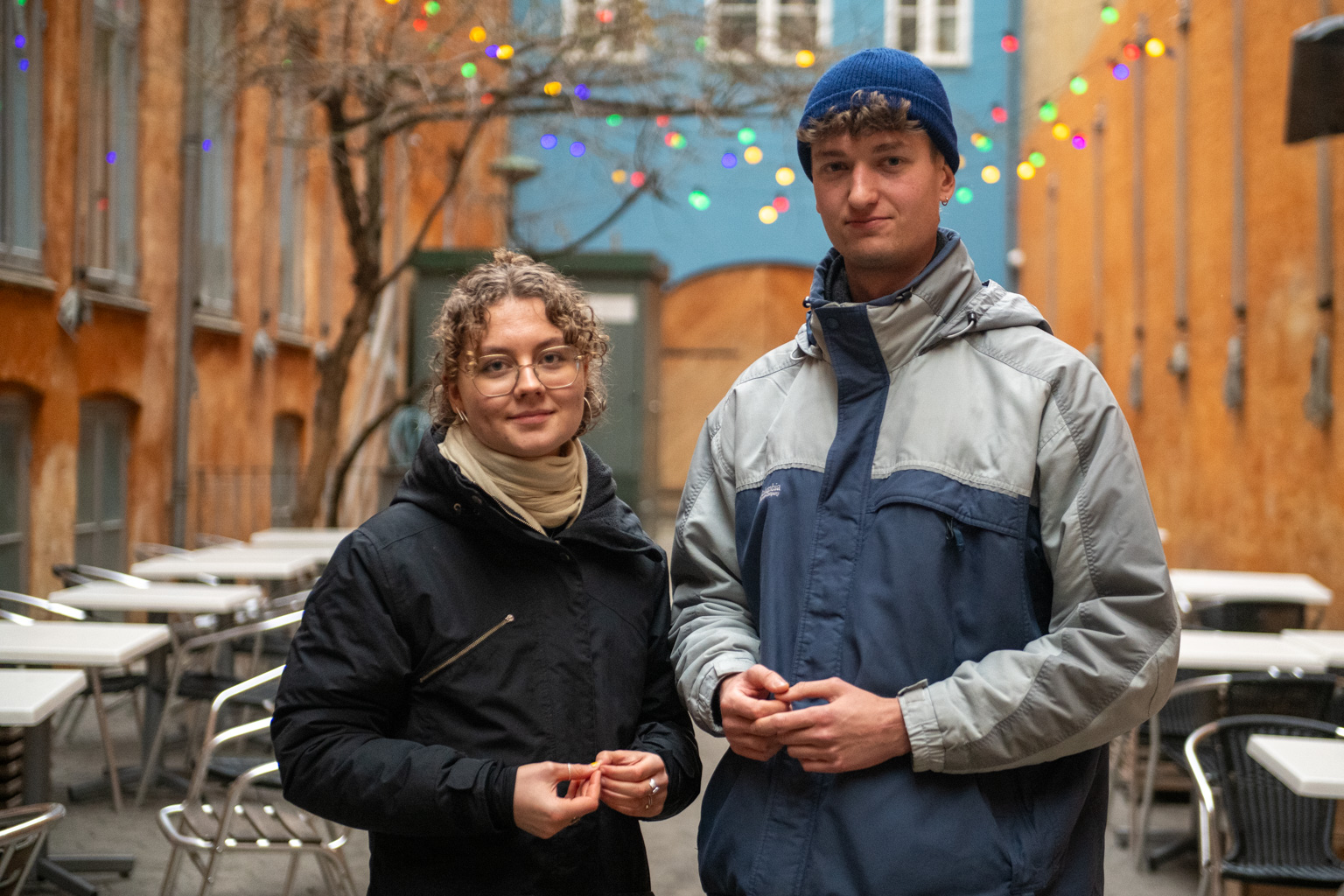
The group behind the open letter calls itself Rethink IFRO. Among its active members are Nora Birkmose and Max Berger. She is in her second year of the bachelor’s programme in Environmental and Food Economics, while he is in the final year of the master’s programme in Environmental and Natural Resource Economics.
The department has already listened to some of their demands, they explain. This includes a compulsory bachelor’s course in ecological economics that is to be set up as a result of Rethink IFRO’s efforts. It is a step in the right direction. But it is not enough, says Nora Birkmose:
»The entire programme focuses heavily on neoclassical economics, which we see as too narrow an approach to the discipline,« she says.
Many of us IFRO economists are very interested in interdisciplinary issues. That’s why we didn’t just choose to study economics
Nora Birkmose, bachelor’s student at IFRO
»The department has lots of interdisciplinary resources at its disposal — but they are not being used to offer interdisciplinary teaching. This is a shame, as many students want a more diverse course offering and the opportunity to explore other economic schools and perspectives.«
Topics that the students would like to see more of include gender and inequality, biodiversity, climate justice and degrowth — a theory that offers a critical perspective on economic growth. Several elective courses on these topics are available, says Max Berger. But it is just difficult to be allowed to take them:
»Either they cannot be approved at all, or you might get a single course approved,« he says, explaining that this is partly due to the limited number of ‘free’ ECTS credits available in addition to the compulsory courses.
»We sense that this is also about these electives not being ‘economic’ enough — meaning classically economic. But that is precisely why we think it is important to take them,« he continues.
Nora Birkmose adds:
»Many of us IFRO economists are really interested in interdisciplinary issues. This is the reason we didn’t just choose to study economics.«
It is not that they do not want to be taught classical, market-based economics at all, the two students emphasise. They just also want to learn how to approach it critically.
»We want a greater focus on the fact that neoclassical economics is not a neutral perspective,« says Max Berger.
»Mainstream economics also has a clear ideology behind it. Economics is always political. But we have the experience, unfortunately, that some of our lecturers are blind to this,« he adds.
»It would improve our understanding — including our understanding of neoclassical economics — if we were also introduced to other schools of economic thought and could therefore see each of their limitations,« says Nora Birkmose.
READ ALSO: Critical economics students: »We are producing inside-the-box thinkers«
The blind spots that Rethink IFRO are concerned about are reinforced by another issue.
The compulsory course in the philosophy of science Videnskabsteori — the subject in which students learn to think critically about what science (including economic science) is — is not placed until the third year of the bachelor’s degree.
»So it is only when you have been through almost all of your courses and acquired a great deal of knowledge, that you are you supposed to learn what this knowledge is, and to think critically about it. But it should be one of the first things,« says Nora Birkmose.
Max Berger adds that it does not help that the course is shared with students who are not studying economics at all:
»There are particular features of economics as a discipline that we should learn to approach critically, also from a philosophy of science perspective. And they are overlooked when the course has to be so broad,« he says. Nora Birkmose agrees:
»It ends up giving a superficial view of how knowledge is produced.«
Rethink IFRO’s concerns have met wide support among students. They have also been the focus of attention outside the university. It is, after all, of real consequence what it is that the environmental economists of the future are being taught. IFRO researchers are advisers to government ministries and are often used as experts in influential economic and climate councils. What students learn now, are things that some of them will one day have to give advice on to people in power. The students are well aware of this influence.
»We understand that we are living in an age of polycrisis,« says Max Berger.
Right now we are mostly learning how the world already works — not how it could be instead
Max Berger, master’s student at IFRO
»As a society, we have to tackle climate change, biodiversity loss, economic inequality, political polarisation, and several other issues. All at the same time.«
»And neoclassical economics, which is currently the basis of almost our entire programme, simply ignores many of these factors. That means that the research that we are able to produce, and the decisions we may help make in the future, do not relate to the real world.«
The wish to build a better future is what motivates many IFRO students, says Max Berger.
»Many of us chose the programme because we thought it would give us the tools to change the world. But as it is now we are mostly learning about how the world already works — not how it could be instead,« he says:
»We are learning to reproduce the problems rather than solve them.«
If, on the other hand, they had a more diverse curriculum, future environmental economists would be able to help push the world forward, says Nora Birkmose:
»If we expand our toolbox with more economic approaches, we will also be able to find new solutions and understand problems from other angles.«
»We will quite simply get better at our profession.«
The students in Rethink IFRO have invited department management to a meeting about the proposals outlined in their open letter. No date has been set yet, but the hope is that it will take place in February, says Nora Birkmose.
The University Post has put the students’ criticism to the department management. In a written response, Deputy Head of Department Mette Weinrich Hansen confirms the upcoming meeting and writes:
»We are pleased with our good and committed students at IFRO, and we are always happy to invite dialogue on the development of the teaching and the quality assurance of our programmes and courses.
We can confirm that a meeting will be held within the coming weeks between the heads of studies of the economics programmes, the undersigned, and Rethink IFRO. The date has not yet been set, but it will be as soon as possible.«
»We have already invited a member of Rethink IFRO to take part in a development group for the new course in ecological economics together with several academic staff members who will plan the course.
IFRO is much more than economics courses. We are responsible for three non-economics master’s programmes, and we offer many different courses in, for example, sustainability, global development and food systems. All programmes also have electives where students can decide entirely for themselves what to take. Here they can choose from a wide range of courses that are not economics-based or rooted in the neoclassical school.
We look forward to talking with the students.«
This article was first written in Danish and published on 11 February. It has been translated into English and post-edited by Mike Young.