





Universitetsavisen
Nørregade 10
1165 København K
Tlf: 35 32 28 98 (mon-thurs)
E-mail: uni-avis@adm.ku.dk
—
Working environment
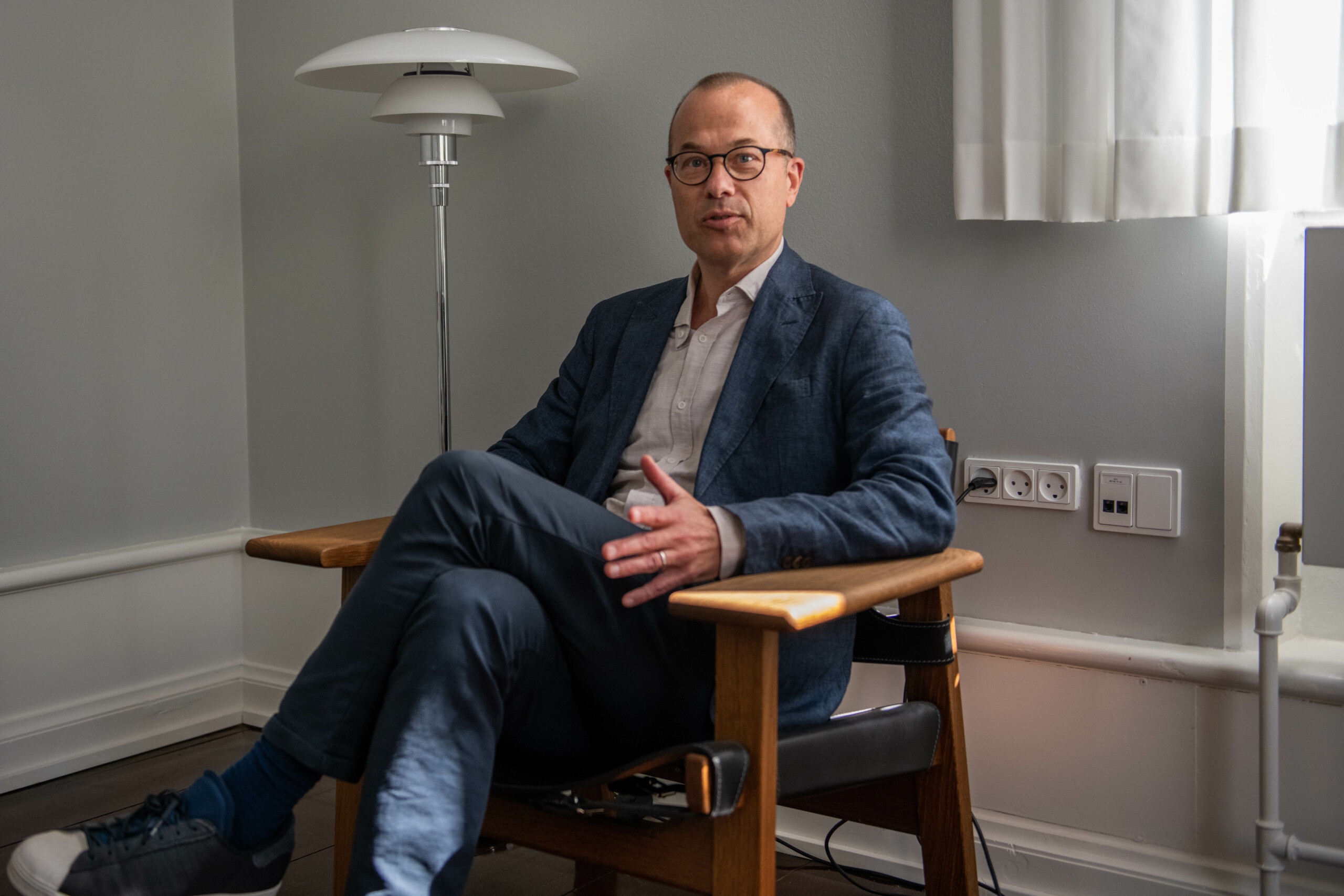
Well-being — 12 percent of the technical-administrative staff covered by the University of Copenhagen’s administrative reform report sickness absence due to work pressure and stress. University Director Søren Munk Skydsgaard calls the figure »too high« and links it to new managers, new tasks, and an administration where not everything has yet fallen into place.
There is one figure in the new workplace assessment (WPA) among administrative staff at the University of Copenhagen that particularly stands out to University Director Søren Munk Skydsgaard.
Twelve percent of staff say that, within the past 12 months, they have been absent due to sickness caused by work pressure, stress, or other work-related demands.
Change-related WPA 2026
You can explore all the results from the new WPA yourself by clicking here (requires UCPH login).
»That is too high. And it is something we are going to work on,« Søren Munk Skydsgaard tells Uniavisen, which asked him what management takes away from the results of the new well-being survey.
The WPA measures both the psychological and physical work environment and was conducted among TAP-AS employees in the university administration and in administrative units at both faculty and department level.
TAP-AS refers to technical-administrative staff whose work is primarily administrative, and all employees included in the survey were covered by the administrative reform.
The University of Copenhagen conducts an ordinary, legally required WPA every three years, most recently in 2025. The new survey is an extraordinary change-related WPA, which the university is also required to carry out as a follow-up to the administrative reform that took effect on 1 March 2025. The survey takes the temperature of the work environment among administrative staff one year after the reform.
READ ALSO: Workplace misconduct reported by ten per cent of staff
The University Director’s overall reading is that the WPA contains warning signs, but also positive elements to build on.
»Overall, I think the WPA shows that there are things we need to work on. But also that there is a good foundation to build on,« he says.
He notes that the overall indicators for job satisfaction and pride remain relatively high. In the psychological WPA, both job satisfaction and pride score 4.0 out of 5, while 73 percent in the physical WPA say that they generally have a good physical work environment.
But beneath the respectable averages lies a series of problems that the University Director says management must take seriously.
The administrative reform has meant that many employees have been given both new tasks and new colleagues.
And while Søren Munk Skydsgaard stresses that overall job satisfaction remains at the same level as before, he sees a connection between the reform and the increase in stress-related sickness absence.
»I think it is due to the major change. New managers, new colleagues, new tasks, and interfaces that are still not in place,« he says.
It is not good that around one in ten experiences bullying
The point is not necessarily that more people are experiencing stress than before. But the strain may have become more severe for those affected, he says:
»Even though stress overall is at the same level as in previous measurements, the intensity of stress for the individual may have increased to such a degree that they become ill because of it. And I do think that can be linked to the major organisational reform, because it is a huge change.«
In his view, management’s follow-up should therefore not only be about well-being initiatives, but also about the way the new administration functions in everyday life. Both now and in the future.
»If my hypothesis about the cause is correct, then it is about making clear what the task is and clarifying the interfaces. It is also about making processes simpler and better supported by IT,« he says.
One of the purposes of the administrative reform was precisely to create more uniform workflows and a more cohesive administration.
The question is why, one year after the reform took effect, the University of Copenhagen is still struggling with the same problems.
The Director’s answer is that management faced a choice. Either the university could wait to reorganise until all processes, workflows and IT systems were complete — or the new organisation could help develop them.
Management chose the latter.
»We chose to reorganise in such a way that employees and managers who know the core business, and who also bring in a lot of best practice, have themselves helped shape the new workflows,« he says.
According to Søren Munk Skydsgaard, this is why uncertainties remain among administrative staff.
But he rejects the idea that the uncertainties employees are currently experiencing are a sign that the reform has failed.
»I do not accept the premise that it has not succeeded. But it takes time.«
Søren Munk Skydsgaard wants the University of Copenhagen to return to somewhere near the previous level of stress-related sickness absence, which he estimates was around seven percent.
»And of course preferably lower,« he says.
But he will not put a date on when the goal should be reached.
»I don’t dare say. I think that would be rash of me. But it is clear that it should not be something that drags on for a long time,« he says.
The psychological WPA also shows that nine percent of employees have, within the past year, been subjected to bullying or other gross, demeaning or offensive acts in connection with their work. Among them, 40 percent state that a manager was responsible for the behaviour.
And that figure is too high, says Søren Munk Skydsgaard.
»It is not good that around one in ten experiences bullying,« he says.
People do not always want to report something, but it certainly should not be because employees do not know where they can turn
But he adds that the figures should be read with an awareness that the WPA’s definition of bullying is broad.
»Some of what is included is being assigned tasks that you do not think are the right ones. You may feel disadvantaged in relation to the good tasks. And you may feel that you do not have sufficient information to solve your tasks,« he says.
When managers appear as perpetrators in the WPA, it may therefore, according to the Director, in some cases be about decisions on the allocation of tasks that respondents disagree with, he assesses:
»This is in no way to downplay it, but I can imagine that a significant share of what has concerned managers may have to do with the allocation of tasks, where one may not agree with the management decision.«
But he also stresses that employees at the University of Copenhagen should not experience bullying or other gross acts.
»We need to have a culture where people speak properly to one another. That is something we need to work on,« he says.
The WPA shows that many of the employees who have experienced offensive behaviour do not feel that the problems are being dealt with.
In cases of bullying, 39 percent answer no when asked whether the problem has been handled, and 39 percent answer »don’t know«. In cases of discrimination or unequal treatment, 57 percent answer no, while among those who have experienced physical violence or threatening behaviour, 51 percent do not feel that the problem has been dealt with.
For Søren Munk Skydsgaard, part of the answer is to make it clearer what employees can actually do, especially when the problem concerns their own manager.
»If it concerns a manager, it is full of dilemmas, because that is the very relationship that is not working,« he says, mentioning union representatives, health and safety representatives, HR and the manager’s own manager as possible places to turn.
»At the very least, it must be easy to know who you can go to. People do not always want to report something, but it certainly should not be because employees do not know where they can turn.«
Another area that stands out in the psychological WPA is employees’ development opportunities.
Ninety-four percent of employees have had a staff development interview within the past 12 months, and 87 percent say that, in connection with the interview, an oral or written agreement was made describing their need for development and training.
Even so, »your development« is the lowest-rated of the overall themes in the WPA, with a score of 3.3 out of 5.
The University Director recognises this tendency from previous WPAs.
»There is a challenge in ensuring that the conversation becomes what it is intended to be. It is, after all, a staff development interview,« he says.
The challenges with noise and indoor climate have become more apparent
Formally, the system works: the interviews take place, and in the vast majority of cases agreements are made. But employees do not necessarily feel that the staff development interview actually supports their development.
»It is not because nothing is agreed during the interviews. But how do you get the final step of ensuring that there is also a perception that the staff development interview is important for one’s development?« the University Director asks.
He answers his own question by saying that the unsatisfactory figures give the University of Copenhagen reason to discuss what the staff development interview should actually be, and how the conversations can become more meaningful for employees.
»I really do not want to point fingers at anyone. I do not actually think there are bad intentions or anything like that. But we need to have a conversation in the liaison committees and generally in the administration about what the staff development interview is and should be,« he says.
Looking at the physical work environment, there are also some results that Søren Munk Skydsgaard links to the administrative reform.
Noise and indoor climate are, as before, the lowest-rated physical conditions. Twenty-seven percent disagree or strongly disagree that they can generally do their work without being disturbed by noise. Twenty-five percent disagree or strongly disagree that the indoor climate is good in the places where they work.
The explanation lies both in the buildings and, to some extent, in the reform itself, Søren Munk Skydsgaard assesses.
Some employees have temporarily moved into buildings that were not entirely ready. Others have moved into new buildings with teething problems. And the reform has meant that the University of Copenhagen has generally reduced the number of square metres allocated to administrative units.
»We did that for several different reasons, but also to reduce the need to cut positions. Instead, we chose to save on bricks and mortar,« he says.
The price is that employees sit closer together.
»And that means that the challenges with noise and indoor climate have become more apparent.«
For that reason, Søren Munk Skydsgaard stresses, there is still a focus on taking this into account when buildings are renovated and when ventilation, interior design and meeting facilities for employees are worked on.
At the same time, according to the University Director, there are also opportunities locally to create good ground rules for how offices are used.
»It is a management task to ensure good conditions. But it is a big problem, and it is also a bigger problem than I can solve in the short term,« he says.
The psychological WPA shows that employees assess their colleagues and their day-to-day management relatively positively, while trust in the university’s upper levels of management is lower. Trust in day-to-day management achieves an average score of 3.9, while the University of Copenhagen’s management scores 3.5.
The difference makes an impression on Søren Munk Skydsgaard. But it does not surprise him.
Managers are not leaning back and thinking that everything is fine. I simply do not think there is a risk of that
The further away managers are, the lower they are typically rated, he says. When the criticism concerns the administrative reform, however, it naturally hits top management.
»Not everyone thinks the administrative reform was an equally good idea. And that is a decision made by top management. The most important thing here is that trust in the immediate manager is generally good.«
In both the psychological and physical WPA, managers generally assess their work environment more positively than employees do. But Søren Munk Skydsgaard rejects the idea that this means management underestimates the problems.
»Managers are not leaning back and thinking that everything is fine. I simply do not think there is a risk of that,« he says.
According to Søren Munk Skydsgaard, the task is not first and foremost to get employees to rate top management more highly, but to solve the underlying problems identified by the WPA responses.
At the same time, the university’s senior management must become better at explaining the strategic choices being made, he says.
What happens now?
Søren Munk Skydsgaard explains that management will now follow up on the WPA in liaison committees, the occupational health and safety organisation, and the university’s administrative units.
Focus areas will be identified, but he does not want to set specific targets for how much individual results should improve, or when that should happen.
»You have to be careful with global targets of that kind,« he says.
According to the University Director, the challenges vary from unit to unit. Management therefore cannot necessarily solve them using the same approach everywhere, he says, while stressing that management takes the results seriously.
»These results and the work on the work environment are something we care a great deal about.«
But he does not promise quick solutions:
»I can’t perform magic either,« says Søren Munk Skydsgaard.