



Universitetsavisen
Nørregade 10
1165 København K
Tlf: 35 32 28 98 (mon-thurs)
E-mail: uni-avis@adm.ku.dk
—
Politics
Goverment Platform — Universities Denmark welcomes the new government’s focus on research, while student representatives criticise the lack of attention to higher education and student grants.
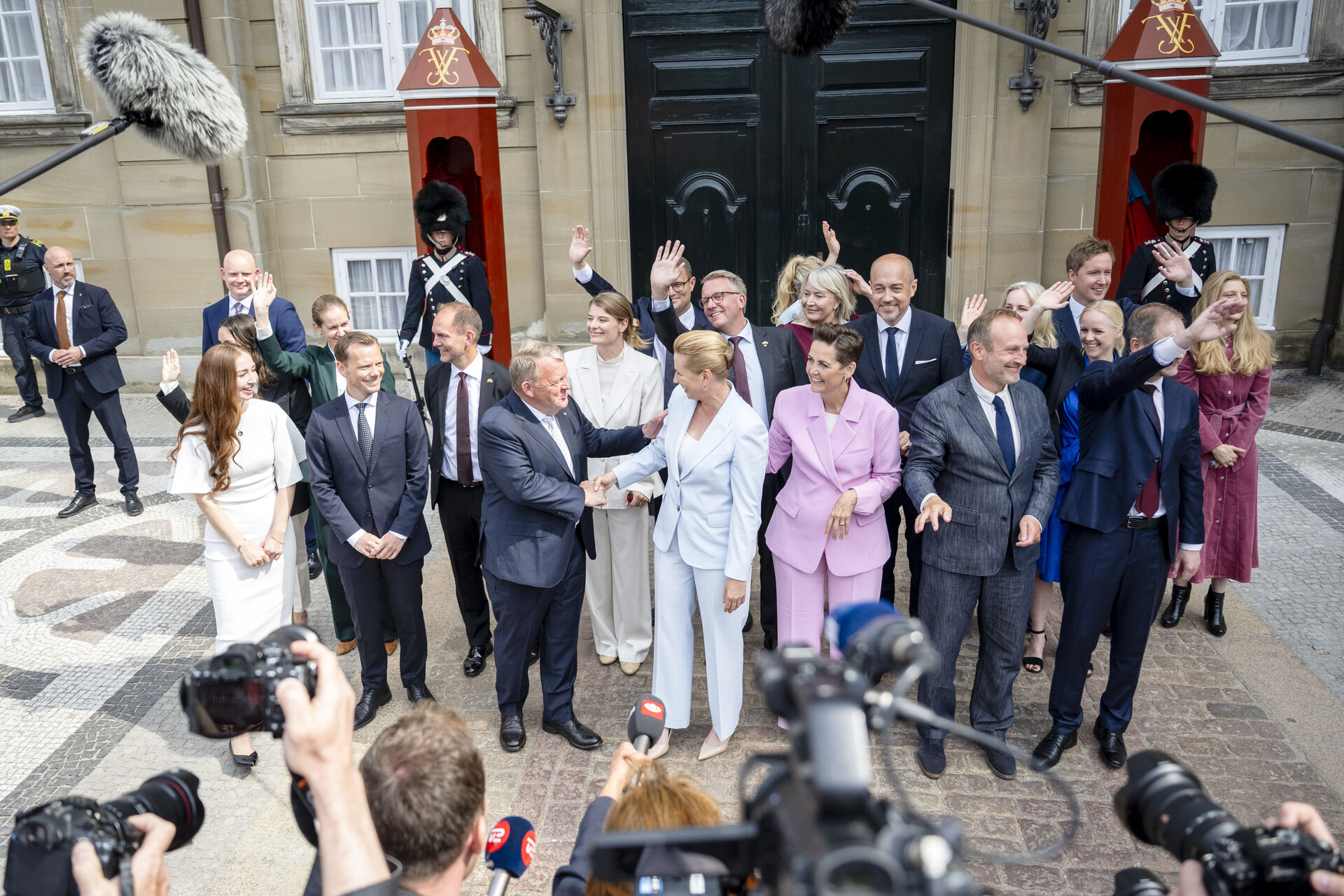
It took record-long negotiations before Denmark’s new four-party coalition government, consisting of the Social Democrats, Green Left (SF), the Moderates and the Danish Social Liberal Party (Radikale Venstre), could finally step forward and present its government platform and full cabinet.
The new government platform
The government will introduce a new national AI strategy for the entire education sector.
The master’s degree reform will be softened so that 90 per cent of students in 2028 can still enrol in a two-year, 120 ECTS master’s programme. Under the original reform, 20 per cent of master’s admissions in 2028 were to be allocated to professional master’s programmes or shorter master’s degrees.
The government will create 2,000 new bachelor’s places within STEM subjects.
At least one per cent of GDP will be allocated to publicly funded research.
DKK 1 billion will be allocated permanently to education and research.
The government will present a national strategy for the quantum sector: From Quantum Research to Quantum Industry.
Source: The Government Platform.
Although the government platform covers much more than education and research, it nevertheless signals several changes in these areas. Among other things, the government plans to introduce a new national AI strategy for the education sector, soften the university reform and create 2,000 new bachelor’s places within STEM subjects.
Overall, Jesper Langergaard, Director of Universities Denmark, is pleased with what he sees when reading through the new government platform. In particular, he notes that the government maintains its commitment to allocating at least one per cent of gross domestic product (GDP) to publicly funded research.
»In the course of the election campaign, there was some speculation that these ambitions risked being weakened, so it is very positive that the government will continue to spend one per cent of GDP on research,« Jesper Langergaard tells Uniavisen.
At the same time, the director welcomes the government’s proposal to create 2,000 additional bachelor’s places in the so-called STEM disciplines – science, technology, engineering and mathematics.
»It is really good that there will be room for more students,« says Jesper Langergaard.
READ ALSO: UCPH braces for master’s degree reform: »We can’t afford to get it wrong«
The new government platform proposes slowing down the first phase of the much-debated master’s degree reform.
The previous plan was that 20 per cent of master’s admissions in 2028 would be moved to new degree formats: 10 per cent to a shorter master’s programme and 10 per cent to a professional master’s programme. The government now intends to propose to the parties behind the reform agreement that 90 per cent of students in 2028 should still be able to choose a traditional two-year full-time master’s degree.
I have never seen a government platform in which education plays a smaller role
Anton Teglbjærg, Chairperson, Danish National Union of Students
Jesper Langergaard sees this as a slight softening of targets that have been heavily criticised across the university sector.
»But whether the government still intends to stick to the targets set for 2032, we simply do not know. So it is a little unclear what this actually entails. But all things considered, it certainly seems positive that they may be trying to turn this large experiment into a somewhat smaller experiment,« says Jesper Langergaard.
The change has not yet been adopted and will require support from the parties behind the original reform agreement.
Anton Teglbjærg, chairperson of Danish National Union of Students (DSF), is not quite as positive about the new government platform.
In general,
»I have never seen a government platform in which education plays a smaller role,« Anton Teglbjærg tells Uniavisen.
It is a clear advantage that the same minister will now complete the university reform
Jesper Langergaard, Director of Universities Denmark
DSF is particularly concerned that there is no focus on State Educational Supoort Grant (SU), despite the fact that both Green Left and the Danish Social Liberal Party, as well as the two supporting parties, the Red-Green Alliance and The Alternative, campaigned on reinstating the sixth year of SU support – something the government platform does not propose.
»We are highly critical of the absence of any mention whatsoever of the SU,« says Anton Teglbjærg.
At the same time, DSF is concerned that the government has singled out STEM subjects as a priority area in connection with the creation of the 2,000 additional bachelor’s places. Instead, universities should have greater freedom to assess where new study places are needed, he argues.
“We are quite critical of this kind of detailed political steering,” says Anton Teglbjærg.
The same criticism comes from Mads Eriksen Storm, Head of Education and Research Policy at the Danish Chamber of Commerce. Although he believes the new government platform takes »some positive steps in the right direction« and welcomes the creation of additional study places, he regrets the exclusive focus on STEM programmes.
»We would have liked to see a broader approach that looks at society’s needs rather than pointing to specific areas in advance,« he says, continuing:
»There is no doubt that there is a shortage of STEM graduates, but if you look purely at employment outcomes, social science programmes actually have lower unemployment rates.«
According to Mads Eriksen Storm, the expansion of STEM programmes is just another example in a long line of politically driven admission controls, and he would have preferred to see the establishment of a national skills council.
»So that we can actually have deeper discussions and conduct better analyses of what society needs. Instead of jumping from one issue to the next and creating new admission-control models every time a new problem arises,« he says, continuing:
»First it was international students, then unemployment, then the urban-rural divide, then academics versus non-academics. By now it has become such a patchwork that even for someone who works with these issues every day, it is difficult to make sense of.«
Christina Egelund of the Moderates will continue as Denmark’s Minister for Higher Education and Science in the new government. Both Jesper Langergaard and Anton Teglbjærg welcome the decision, arguing that it creates continuity.
»Christina Egelund has been very engaged and willing to listen, and it is a clear advantage that the same minister will now complete the university reform,« says Jesper Langergaard.
Anton Teglbjærg agrees:
»Christina has also been good at involving students.«
Universities Denmark hopes the minister will work to attract more international research talent to Denmark.
»We would have liked that to be stated a little more clearly in the government platform,« he says.
On LinkedIn, Christina Egelund has also received congratulations from the Rector of the University of Copenhagen, David Dreyer Lassen.
»We at the University of Copenhagen look forward to working together: from the master’s degree reform and quantum research to artificial intelligence, continuing to help develop Denmark through a strong university sector across all fields of knowledge, and ensuring that new knowledge reaches and benefits everyone – citizens and businesses, civil society and the public sector.«
Uniavisen has attempted to arrange an interview with the Rector about his reaction to the new government platform, but this has not been possible.